Introduction
You tried an apple cider vinegar rinse and your hair felt amazing—smooth, shiny, refreshed. Two weeks later, the same treatment does nothing. You switched to a clarifying shampoo and experienced incredible lightness after the first use, but now your hair feels dry and the buildup seems to return within days. You're washing more frequently, alternating treatments, and still can't maintain that clean, healthy feeling.
The frustration is real: Why does ACV help temporarily, then stop working? Why does clarifying shampoo feel amazing once, then seem useless?
Here's what most articles won't tell you: the problem isn't how often you're using these treatments. The problem is using the wrong tool for the wrong job. Hard water creates mineral buildup that requires fundamentally different chemistry than the treatments most people reach for. Understanding this distinction—between what removes product residue versus what removes mineral deposits—is the key to actually solving hard water hair problems rather than just masking them temporarily.
This guide breaks down exactly what ACV rinses, clarifying shampoos, and chelating treatments actually do, why their effects differ so dramatically, and how to build a frequency schedule that works with your water's specific chemistry rather than against it.
Table of Contents
- Introduction
- Why Hard Water Buildup Is Different From Product Buildup
- ACV Rinse: What It Helps (And What It Doesn't)
- Clarifying Shampoo: Powerful but Often Misused
- Chelating Shampoo (EDTA): The Missing Piece
- How Often Should You Use Each One? The Real Answer
- Common Mistakes That Make Hard Water Hair Worse
- Frequently Asked Questions
- Conclusion
Why Hard Water Buildup Is Different From Product Buildup
Before we can understand which treatments work, we need to clarify what we're actually trying to remove. Many people—and even many hair care articles—treat all "buildup" as the same problem requiring the same solution. This fundamental misunderstanding is why standard treatments provide only temporary relief.
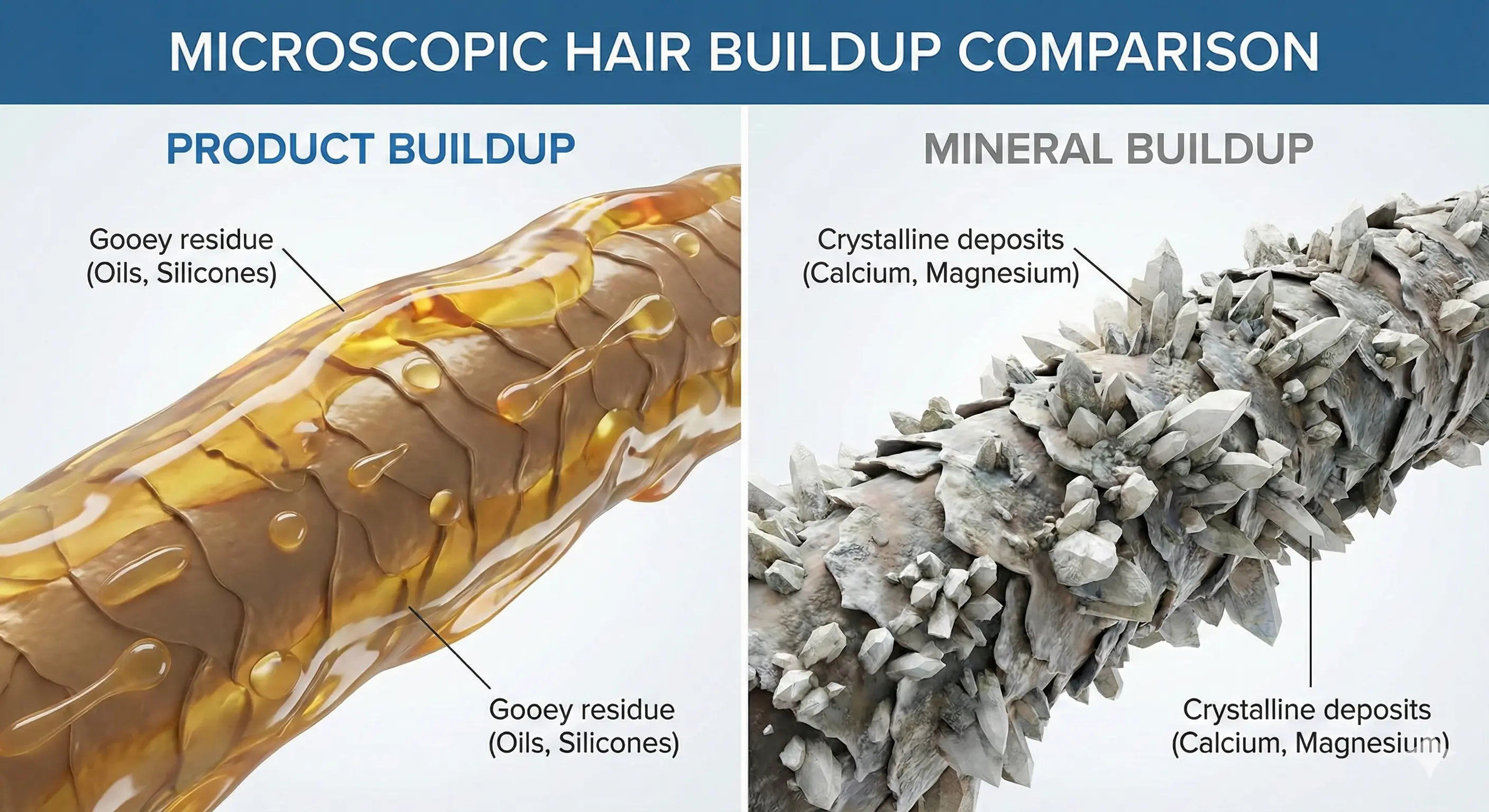
Product buildup consists of oils, silicones, waxes, and styling product residues that accumulate on hair over time. These substances are organic compounds, typically oil-based or designed to be oil-soluble. They sit on the hair surface or coat the cuticle, creating weight, dullness, and reduced product effectiveness.
Mineral buildup from hard water is an entirely different beast. Calcium and magnesium ions in hard water form ionic bonds with the keratin proteins in your hair shaft. These aren't surface coatings you can simply scrub away—they're chemical attachments between positively charged metal ions and negatively charged protein sites. Each wash deposits a fresh layer of minerals that bonds to existing deposits, creating progressive accumulation that regular cleansing cannot address.
The distinction matters enormously because:
- Oil-based buildup responds to surfactants—the cleansing agents in shampoos that dissolve oils and allow them to be rinsed away with water. More aggressive surfactants (like sulfates in clarifying shampoos) remove this buildup more thoroughly.
- Mineral buildup doesn't respond to surfactants at all. You can use the strongest clarifying shampoo available, and while it might remove some surface layer, the bonded minerals remain attached to your hair proteins. The chemistry required to break ionic bonds is completely different from what breaks down oils.
This is why people cycle through clarifying products, ACV rinses, and deep-cleansing shampoos with increasingly disappointing results. These treatments work beautifully on product buildup but do almost nothing for the actual problem—mineral deposits accumulating with each wash.
For comprehensive understanding of how these mineral bonds form and why they create such persistent damage, see How Hard Water Damages Hair (And Why It Feels Dry & Greasy at the Same Time).
ACV Rinse: What It Helps (And What It Doesn't)
Apple cider vinegar rinses have become enormously popular in natural hair care communities, often touted as the solution for hard water damage. The reality is more nuanced—ACV provides genuine benefits, but not the ones most people think.
What ACV Actually Does
- pH adjustment: ACV is acidic (typically pH 2-3), and when diluted properly (1-2 tablespoons per cup of water), it lowers the pH of your hair's surface. Hair's optimal pH is slightly acidic (4.5-5.5), and many shampoos, especially in hard water, leave hair at a higher (more alkaline) pH. The acidic rinse brings pH back into the optimal range.
- Cuticle smoothing: The lowered pH causes the hair cuticle scales to contract and lie flatter against the hair shaft. This mechanical smoothing creates immediate improvements in how hair feels and looks—smoother texture, enhanced shine, reduced frizz, and easier detangling.
- Surface cleansing: The acidic environment can help dissolve some surface deposits and residues, particularly those from alkaline products. This provides a mild clarifying effect.
- Temporary improvement in manageability: All these factors combine to create that "amazing hair day" feeling after an ACV rinse—hair feels lighter, looks shinier, and behaves more cooperatively.
What ACV Doesn't Do
Here's where expectations diverge from reality, and why ACV's benefits prove temporary for people with hard water:
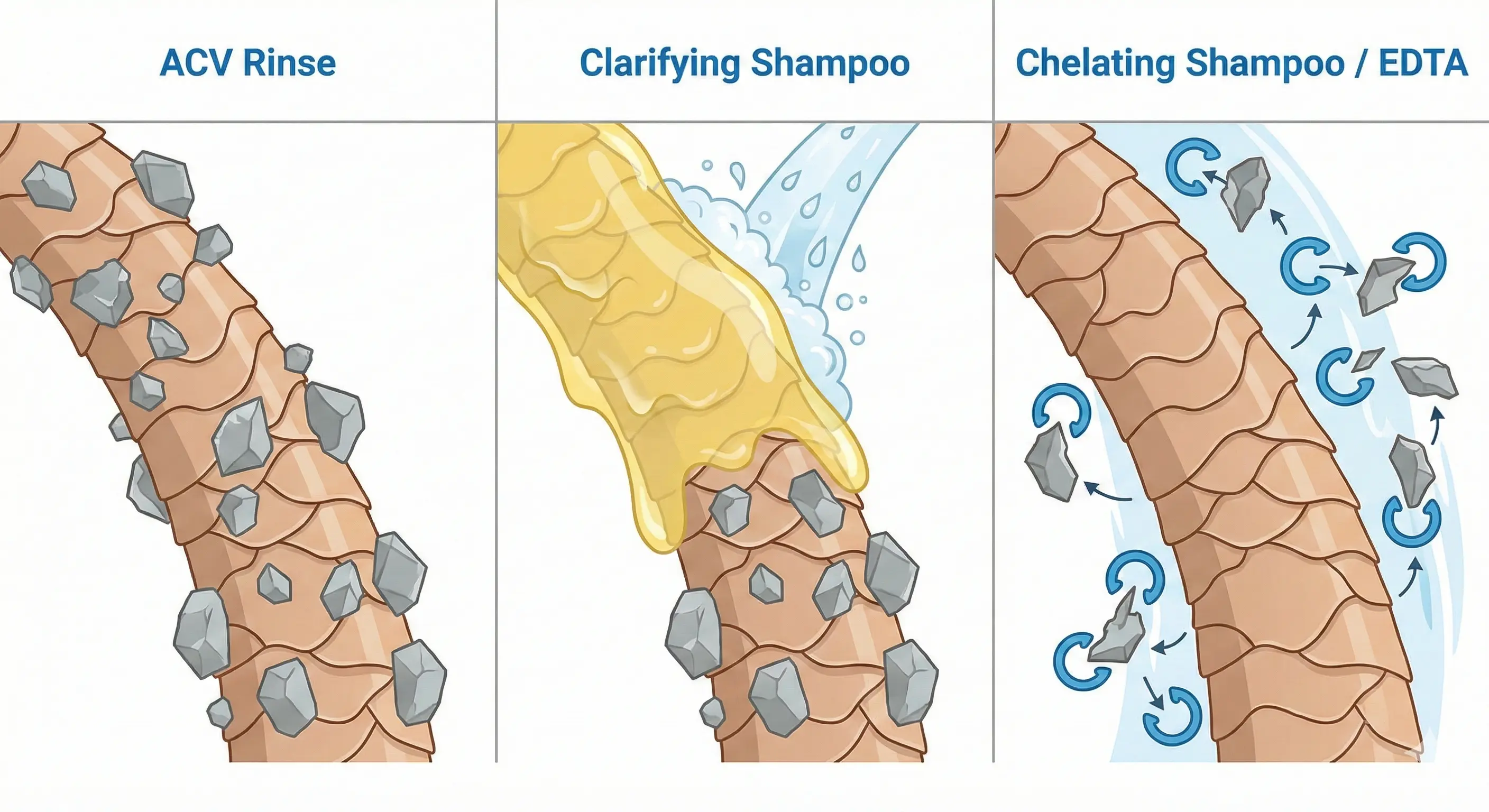
- It doesn't remove calcium deposits. The acidity in ACV is nowhere near strong enough to break the ionic bonds between calcium ions and hair proteins. While it might dissolve tiny amounts of surface minerals, it leaves the bonded buildup completely untouched.
- It doesn't remove magnesium deposits. Same chemistry—the bonds are too strong for a simple acidic rinse to disrupt.
- It doesn't address long-term buildup. ACV can't prevent minerals from re-depositing with your next wash, and it can't remove the layers already attached to your hair shaft.
- It doesn't replace chelating treatment. While ACV improves how hair feels, it doesn't change what's chemically attached to it.
The expert perspective: ACV improves how hair feels—not what's attached to it.
This explains the common pattern: ACV provides dramatic improvement the first few times you use it, then seems to stop working. What's actually happening is that the acidic pH adjustment and cuticle smoothing provide maximum benefit when your hair is only moderately damaged. As mineral buildup continues accumulating beneath the temporarily smoothed cuticle, the cosmetic improvements from pH adjustment become less noticeable. You're getting the same pH benefit, but it can't overcome the worsening underlying mineral problem.
ACV works best as a finishing treatment after you've addressed mineral buildup through proper chelation, not as a primary treatment for hard water damage.
Clarifying Shampoo: Powerful but Often Misused
Clarifying shampoos sit in an interesting middle ground—more aggressive than regular shampoo but still fundamentally designed for product removal rather than mineral removal.
What Clarifying Shampoo Removes
- Styling product residue: Clarifying formulas excel at removing hairspray, gel, mousse, and other styling products that regular shampoo leaves behind.
- Silicone buildup: The stronger surfactants in clarifying shampoos break down silicone coatings from conditioners and styling products that accumulate over time.
- Excess oils: These formulas strip away sebum, heavy oils from conditioning treatments, and oil-based products more thoroughly than gentle shampoos.
- Surface layer of mixed buildup: When mineral deposits and product residue exist together, clarifying shampoo removes the product portion and some loose surface minerals, creating temporary improvement.
This is why clarifying shampoo feels amazing the first time you use it—it strips away months of accumulated product residue in one wash, leaving hair feeling incredibly light and clean. For people who primarily have product buildup rather than mineral buildup, clarifying shampoos can be genuinely transformative.
Why People with Hard Water Stay Disappointed
The same aggressive cleansing that makes clarifying shampoo effective against products creates problems when hard water is involved:
- It strips everything—including protective oils. After clarifying, your hair is extremely clean but also vulnerable and unprotected. When you rinse and condition with hard water, minerals deposit even more readily onto the stripped, porous hair surface.
- It doesn't address the underlying mineral bonds. You might remove a surface layer of mixed buildup, but the calcium and magnesium chemically bonded to your hair proteins remain intact. The improvement is temporary and superficial.
- It can cause over-drying. Because clarifying shampoos are so aggressive, frequent use strips hair of necessary moisture and oils. People with hard water often increase clarifying frequency trying to maintain that clean feeling, which leads to a cycle of over-stripping followed by rapid re-buildup.
- It creates false progress. The dramatic improvement from the first use creates the expectation that this product is "working." When subsequent uses provide diminishing returns, people blame the product, their hair, or their washing frequency—not realizing the real problem (mineral deposits) was never adequately addressed.
The Correct Role for Clarifying Shampoo
In a hard water routine, clarifying shampoo serves a specific, limited purpose: removing product buildup that accumulates between chelating treatments. It's not a replacement for chelation, and it's not a primary treatment for mineral deposits. Used correctly—every 2-4 weeks, always followed by intensive conditioning—clarifying shampoo helps maintain product cleanliness without over-stripping. Used incorrectly—as a frequent attempt to address mineral buildup—it causes more problems than it solves.
Chelating Shampoo (EDTA): The Missing Piece
This is where most hard water routines fail, and where proper understanding creates breakthrough results. Chelating shampoos represent fundamentally different chemistry from both ACV rinses and clarifying shampoos.
What Is EDTA and How Does It Work?
EDTA (Ethylenediaminetetraacetic acid) is a chelating agent—a molecule specifically designed to bind to metal ions. When EDTA encounters calcium or magnesium attached to your hair, it forms a complex with these metal ions that's more stable than the ion-protein bond. Essentially, EDTA "grabs" the minerals and pulls them away from your hair proteins, allowing them to be rinsed down the drain.
This isn't physical scrubbing or dissolving—it's chemical bonding that specifically targets the problem hard water creates. EDTA is the only common hair care ingredient that actually removes bonded mineral deposits.
Other chelating agents found in hair products include:
- Phytic acid (from rice bran and other plant sources)—a gentler, plant-derived chelator that works more slowly than EDTA but provides cumulative benefit with regular use.
- Citric acid—while primarily used for pH adjustment, citric acid has mild chelating properties that help with surface mineral removal.
- Sodium gluconate—a biodegradable chelator gaining popularity in natural formulations, effective though typically less powerful than EDTA.
- Tetrasodium glutamate diacetate—a newer chelating agent offering similar effectiveness to EDTA with better environmental profile.
Why Chelating Shampoo Is Non-Negotiable for Hard Water
If you live in a hard water area and want genuinely healthy hair rather than temporarily improved hair, chelating treatments are essential. Not optional, not "if you can find them," but foundational to your routine.
- It's the only treatment that removes what hard water deposits. Everything else—ACV, clarifying shampoos, deep cleansing, baking soda rinses—works around the edges while the core problem persists.
- It allows other products to work. Once mineral buildup is removed, your conditioners can penetrate, your treatments can absorb, and your styling products can perform as designed. Without chelation, you're applying products to a mineral-coated surface where they sit uselessly.
- It prevents cumulative damage. Regular chelation stops the progressive buildup that leads to severe texture changes, increased breakage, and persistent scalp issues.
- It's not harsh when used correctly. Many people fear chelating shampoos will be drying or damaging, but when formulated properly and followed by appropriate conditioning, they're gentler on hair than the damage hard water causes.
For specific product recommendations and detailed reviews of formulations that balance effective chelation with hair health, see best chelating shampoos.
The key is using products with EDTA or other proven chelating agents rather than products that just claim to be "for hard water" without the active ingredients to back it up.
How Often Should You Use Each One? The Real Answer
Frequency recommendations must account for your specific water hardness, hair type, and current damage level. These aren't universal rules but starting points to adjust based on results.
Frequency Guidelines by Treatment Type
| Treatment | Primary Purpose | Recommended Frequency | Best Used When |
|---|---|---|---|
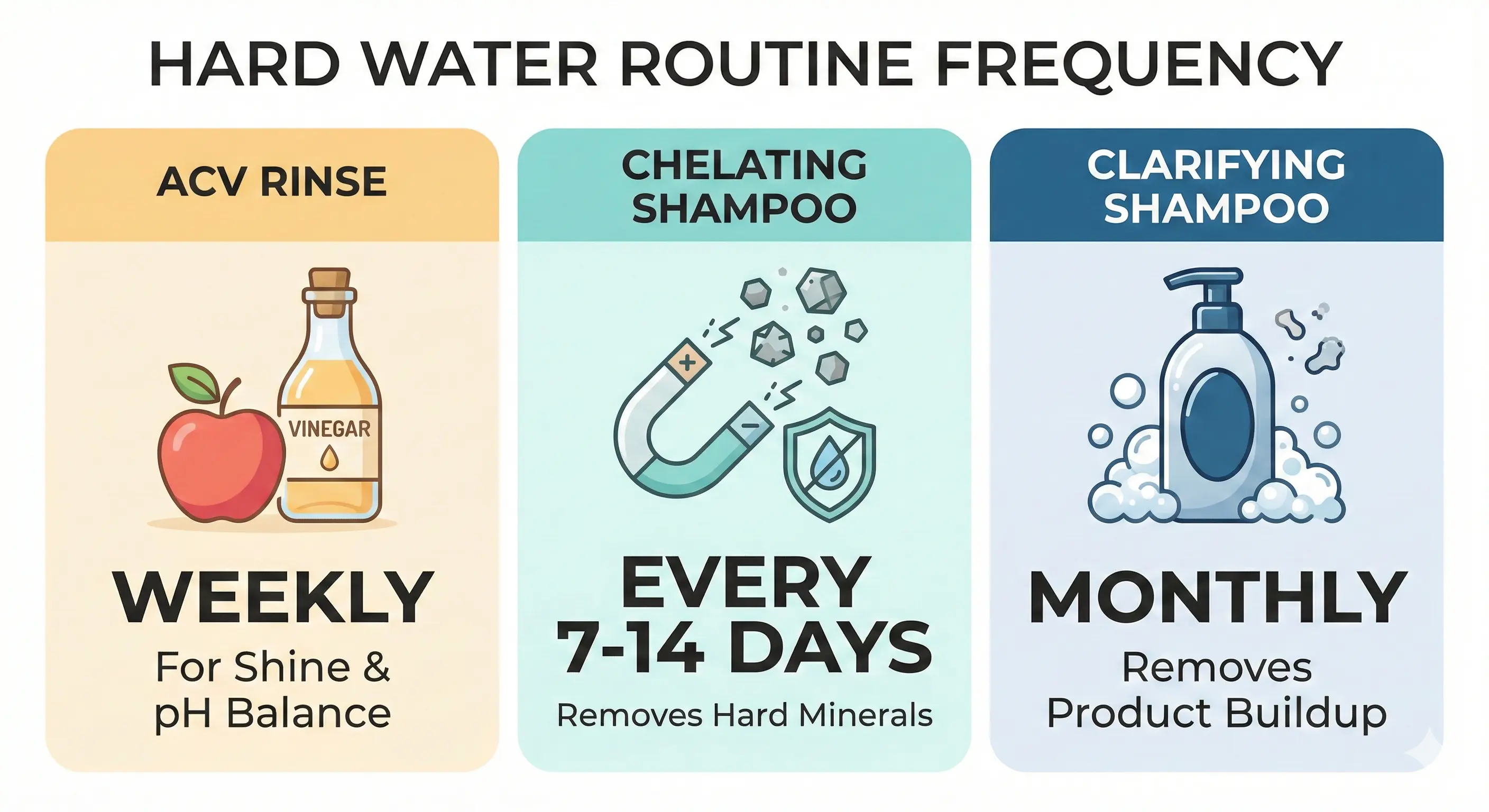
| ACV rinse | pH balance & shine | Once per week | After clarifying or as finishing treatment |
| Clarifying shampoo | Product buildup removal | Every 2-4 weeks | Product accumulation is noticeable |
| Chelating shampoo | Mineral deposit removal | Every 7-14 days | Primary treatment for hard water areas |
| Regular shampoo | Daily/routine cleansing | As needed for hair type | Between chelating treatments |
Adjusting for Water Hardness
- Mild hard water (60-90 ppm):
- Chelating shampoo: Every 10-14 days
- Clarifying: Monthly
- ACV rinse: Weekly if desired - Moderate hard water (91-180 ppm):
- Chelating shampoo: Every 7-10 days
- Clarifying: Every 3 weeks
- ACV rinse: Weekly, especially after chelating - Hard to very hard water (>180 ppm):
- Chelating shampoo: Every 5-7 days
- Clarifying: Every 2-3 weeks (between chelating sessions)
- ACV rinse: 1-2 times per week
- Consider shower filter to reduce frequency needed
Adjusting for Hair Type
- Fine or thin hair:
- May need more frequent chelating (mineral weight is more noticeable)
- Use clarifying sparingly to avoid over-stripping
- ACV rinse helps with volume and bounce - Thick or coarse hair:
- Can tolerate weekly chelating
- Clarifying can be used more freely
- May need less frequent ACV (natural oils distribute better) - Curly or textured hair:
- Chelating is crucial (mineral buildup severely affects curl pattern)
- Clarifying should be minimal (preserve natural oils)
- ACV helps with definition but don't overuse (can loosen curl) - Color-treated or chemically processed:
- Use gentler chelating formulas or reduce frequency slightly
- Minimize clarifying (can strip color)
- ACV helps preserve color vibrancy
Signs You Need to Adjust Frequency
Increase chelating if:
- Buildup returns within 5-7 days
- Hair still feels coated after treatment
- Products don't absorb well
- Scalp feels itchy or tight
Decrease chelating if:
- Hair feels overly dry or brittle
- Texture becomes strawlike
- Excessive shedding occurs
- Scalp becomes sensitive
Common Mistakes That Make Hard Water Hair Worse
Understanding frequency is important, but avoiding these pitfalls is equally crucial for maintaining progress.
Using ACV Too Often
Daily or near-daily ACV rinses provide diminishing returns while potentially creating new problems. Excessive acidity can weaken protein bonds over time, leading to hair that feels mushy or overly soft. The pH swings from alkaline shampoo to very acidic rinse and back create unnecessary stress on hair structure. Once or twice weekly is sufficient for pH balance benefits.
Clarifying Without Intensive Conditioning
Clarifying shampoo strips everything—minerals, products, and protective oils. If you don't follow immediately with deep conditioning or intensive moisture treatment, you leave hair vulnerable and unprotected. This is especially problematic in hard water areas because the stripped, porous hair absorbs minerals even more readily during the next wash.
Ignoring Chelation Entirely
This is the biggest mistake. Many people try every combination of ACV, clarifying treatments, and deep conditioning while never using actual chelating products. They're treating symptoms and ignoring the cause, which explains why nothing provides lasting improvement. If you have hard water, chelation isn't optional—it's foundational.
Believing Shower Filters Replace Chelating Shampoo
Shower filters reduce mineral content in your water, which is beneficial, but they don't eliminate minerals completely and they do nothing about buildup already coating your hair. Even with the best filter, you still need periodic chelating treatments to remove accumulated deposits. Filters are preventive; chelation is curative. You need both for optimal results.
For realistic expectations about what filtration can and cannot do, see Do Shower Filters Really Help With Hair Loss & Hard Water? .
Over-Rotating Treatments
Some people try to use chelating shampoo, then clarifying shampoo, then ACV, then regular shampoo in rapid succession, thinking more variety equals better results. This approach over-cleanses, strips essential moisture, and creates pH chaos. Choose the appropriate treatment for what your hair needs at that moment, use it correctly, and give your hair time to respond before adding another treatment.
Skipping the Recovery Period
After starting chelating treatments, your hair needs time to adjust and recover. Many people expect immediate perfection and switch products or increase frequency when they don't see overnight transformation. Give your chosen routine 3-4 weeks of consistent use before making changes. The damage accumulated over months or years won't reverse in a single wash.
Frequently Asked Questions
What Most People Notice in the First Few Weeks
Many people report that their hair actually feels worse after the first one or two chelating washes. This is completely normal. Chelating shampoos remove mineral layers that were artificially smoothing the hair, revealing the true condition underneath.
Once those deposits are removed and proper conditioning is restored, hair typically becomes softer, more manageable, and easier to hydrate within 3–4 weeks. The key is consistency — not increasing frequency out of frustration.
Conclusion
The frustration you've experienced with ACV rinses and clarifying shampoos that work temporarily then fail isn't because you're using them wrong or because your hair is unusually difficult. It's because you've been using tools designed for different problems than the one hard water creates.
ACV adjusts pH. Useful, beneficial, but doesn't remove minerals.
Clarifying shampoo removes product buildup. Powerful for its purpose, but that purpose isn't mineral removal.
Chelating shampoo with EDTA removes mineral deposits. This is the only treatment that addresses what hard water actually does to your hair.
The breakthrough comes from understanding that hard water requires chelation first, with other treatments serving supporting roles. Once you remove the mineral buildup coating your hair, ACV rinses provide beautiful shine and smoothness. Clarifying shampoos effectively manage product accumulation between chelating treatments. Your regular conditioning products finally work because they can penetrate.
But without chelation as the foundation, you're endlessly treating symptoms while the underlying problem worsens with each wash.
The problem isn't washing too much or not enough. It's choosing the wrong tool for the job.
Start with proper chelating treatment to remove existing buildup. Establish a frequency based on your water hardness—likely every 7-14 days. Use ACV and clarifying treatments as supplements, not primaries. Give the routine 3-4 weeks to show results before making changes.
Your hair can recover from hard water damage, but only when you address the actual chemistry of what's coating and damaging it.
For comprehensive guidance on building a complete routine that integrates all these elements effectively, explore Hard Water Is Ruining Your Hair: Causes, Symptoms & Proven Fixes .
Still not sure if hard water is the real cause of your hair issues? Start by identifying the signs — buildup that returns quickly, products sitting on the hair, dryness paired with greasy roots — before changing your entire routine.