Introduction
Your hair looks dull no matter which products you try. It feels squeaky after washing but turns greasy within hours. Frizz appears out of nowhere, and your once-manageable texture has transformed into something unpredictable and difficult to style. You've switched shampoos countless times, invested in expensive treatments, followed every hair care routine recommended online, and still can't figure out what changed.
Here's what most people don't realize: the problem might not be your hair at all. It's the water you're washing it with.
Hard water affects over 85% of homes in the United States, yet millions of people spend years struggling with damaged hair without ever connecting the dots. The minerals dissolved in your water create an invisible coating on every strand, disrupting your hair's natural balance in ways that seem contradictory and confusing. The same water you use to clean your hair is simultaneously drying it out and making it greasy, weakening the structure while weighing it down with deposits.
This comprehensive guide explains exactly how hard water damages hair, helps you diagnose whether you're dealing with mineral-related issues, and provides science-backed solutions that actually work. Understanding the root cause is the first step toward reclaiming healthy, manageable hair.
In this guide, you'll learn:
- How hard water damages hair at the structural level
- How to diagnose mineral buildup in your specific situation
- Which solutions actually work (and which don't)
- How to build the right routine for your water hardness
Table of Contents
- Introduction
- What Is Hard Water — And Why It Affects Hair So Much?
- Is Your Water Hard? Quick Self-Diagnosis
- How Hard Water Actually Damages Hair: The Science
- Common Symptoms of Hard Water Hair Damage
- What Actually Fixes Hard Water Hair (And What Doesn't)
- Complete Hair Care Routine for Hard Water Areas
- Extreme Hard Water Situations
- When Fixes Go Wrong
- Frequently Asked Questions
- Final Takeaway
What Is Hard Water — And Why It Affects Hair So Much?
Hard water is water that contains high concentrations of dissolved minerals, primarily calcium and magnesium, along with smaller amounts of iron, manganese, and other metals. According to the U.S. Geological Survey (USGS), these minerals accumulate as groundwater passes through limestone deposits. The "hardness" is measured in parts per million (ppm), with water classified as hard when it exceeds 60 ppm.
While these minerals aren't harmful to drink, they create serious problems for hair care. Unlike skin, which has protective oils and can regenerate cells relatively quickly, hair is composed of dead protein cells that cannot repair themselves. Once damaged, the only solution is to cut off the affected portion and grow new, healthy hair. This makes hair particularly vulnerable to cumulative damage from repeated mineral exposure.
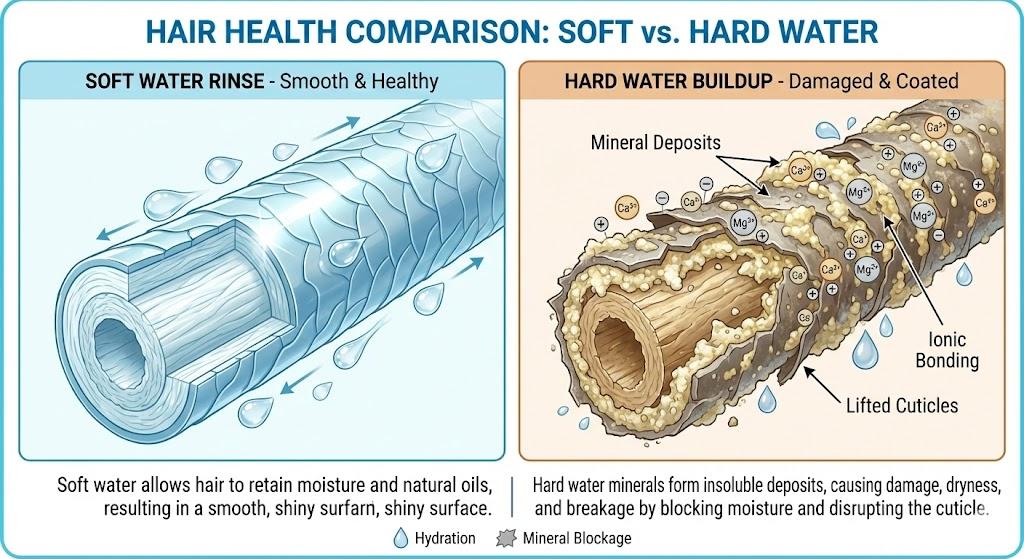
When hard water flows over your hair, the positively charged mineral ions are attracted to the negatively charged proteins in your hair shaft. This creates an ionic bond that regular cleansing cannot break. Each wash deposits a fresh layer of minerals on top of existing buildup, creating a progressive accumulation that fundamentally alters how your hair looks, feels, and responds to styling and treatment.
The issue compounds because these mineral deposits don't just coat the hair surface—they disrupt the entire hair care process. They prevent moisture from penetrating, block conditioning ingredients from working, interfere with chemical treatments like coloring and perming, and create a rough texture that causes tangles and breakage. Even the most expensive products become ineffective when they cannot reach the hair shaft through the mineral barrier.
This explanation is based on cosmetic chemistry principles used in professional hair treatments and dermatological research on mineral buildup.
Hair absorbs and retains minerals more readily than skin for several reasons. The hair cuticle has a scaled structure with spaces where minerals can lodge and accumulate. Hair is also more porous than skin, especially when damaged or chemically treated, allowing deeper mineral penetration. The length of hair means more surface area for deposits to accumulate, and unlike skin cells that shed and renew, hair retains these deposits until they're actively removed or the hair is cut off.
For a deeper comparison of how hard versus soft water specifically impacts different hair types and conditions, explore our detailed analysis in Hard Water vs Soft Water: Which Is Worse for Hair?
Is Your Water Hard? Quick Self-Diagnosis
Before investing in solutions, confirm that hard water is actually causing your hair problems. The symptoms are distinctive and multiple indicators together provide strong evidence.
Signs in Your Hair
Your hair behavior tells the most reliable story. Hard water-affected hair feels waxy or coated even immediately after washing, as if there's an invisible film you can almost feel with your fingers. Shampoo struggles to create a rich lather no matter how much you use, producing thin, disappearing foam instead of full, lasting suds. After drying, hair feels stiff, rough, or has that squeaky-clean sensation that isn't actually clean—it's minerals gripping the hair shaft.
Color-treated hair fades noticeably faster than expected, often with muddy or brassy tones developing within weeks rather than months. Natural hair loses its shine and appears perpetually dull regardless of conditioning treatments. Frizz increases progressively over time without obvious causes like humidity changes or heat damage. Hair tangles more easily and breaks more frequently, especially when brushing or styling.
Perhaps most tellingly, your hair looks and feels worse after washing than before. Instead of the refreshed, bouncy feeling that should follow a shower, your hair seems limp, coated, or somehow dirtier despite being freshly cleaned.
Signs in Your Bathroom
Hard water leaves visible evidence throughout your home. White, chalky residue accumulates on shower doors, faucets, and tile surfaces—this is the same mineral buildup coating your hair. Soap scum forms quickly and is difficult to remove, requiring harsh scrubbing or specialty cleaners. Showerheads develop white crust around the holes and may have reduced water pressure as mineral deposits clog the openings.
Bathtubs show a distinctive ring at the waterline that resists normal cleaning. Glass shower doors develop a cloudy film that never quite looks clean no matter how often you wipe them down. Even your laundry may show signs, with white clothes gradually turning gray or dingy and fabrics feeling stiff after washing.
Signs on Your Skin
While this guide focuses on hair, hard water also affects skin. Research involving water hardness has shown a correlation between high mineral content and an increased risk of atopic dermatitis (eczema), particularly in children, as noted in studies archived by the National Institutes of Health (NIH). Skin may feel tight, dry, or itchy after bathing because the minerals prevent soap from rinsing away completely, leaving a residue that irritates the skin barrier.
Use the table below to quickly confirm if hard water is affecting your hair.
| Sign | Hard Water | Soft Water |
|---|---|---|
| Shampoo lather | Poor, thin, disappears quickly | Rich, creamy, abundant |
| Hair feel after washing | Waxy, coated, squeaky | Soft, smooth, light |
| Color fade rate | Fast (2-3 weeks) | Normal (6-8 weeks) |
| Shower door appearance | Cloudy, white spots | Clear, minimal residue |
| Product effectiveness | Decreasing over time | Consistent results |
| Hair drying time | Longer, feels heavy | Normal, feels clean |
| Scalp condition | Itchy, flaky, tight | Comfortable, balanced |
If you're experiencing multiple symptoms from this table, hard water is very likely affecting your hair health. The more symptoms present, the stronger the indication that mineral deposits are the underlying cause of your hair frustrations.
How Hard Water Actually Damages Hair: The Science
Understanding the mechanism of damage helps you choose the most effective solutions. Hard water doesn't just make hair dirty—it fundamentally changes the hair's chemical and physical structure through several interconnected processes.
Mineral Buildup Creates a Physical Barrier
Calcium and magnesium ions in hard water bond ionically with the keratin proteins that make up your hair shaft. Scientific studies published by the National Center for Biotechnology Information (NCBI) have shown that hair treated with hard water demonstrates significantly decreased tensile strength compared to hair treated with distilled water. This buildup acts as a physical barrier that prevents moisture from penetrating the hair shaft.
This buildup acts as a physical barrier that prevents moisture, conditioning agents, and treatment products from penetrating the hair shaft. Your expensive deep conditioner cannot work if it cannot reach the hair cortex through the mineral layer. Hair oils slide over the surface without being absorbed. Even water itself struggles to penetrate, which is why hard water-damaged hair takes longer to fully wet during washing and longer to dry afterward.
Cuticle Disruption and Damage
Healthy hair has a smooth outer layer called the cuticle, composed of overlapping scales similar to roof shingles. When these scales lie flat, hair appears shiny, feels smooth, and retains moisture effectively. Hard water minerals wedge themselves between these scales, forcing them to lift and remain in an open position even after washing and conditioning.
Lifted cuticles create multiple problems simultaneously. Moisture escapes more easily from the hair cortex, leading to genuine internal dryness regardless of how much you condition. The rough surface catches light irregularly rather than reflecting it smoothly, eliminating natural shine. Open cuticles also catch on each other during brushing and styling, causing tangles, knots, and mechanical breakage. The hair becomes porous in an unhealthy way, absorbing environmental moisture that causes frizz while simultaneously losing internal hydration.
Blocked Natural Oil Distribution
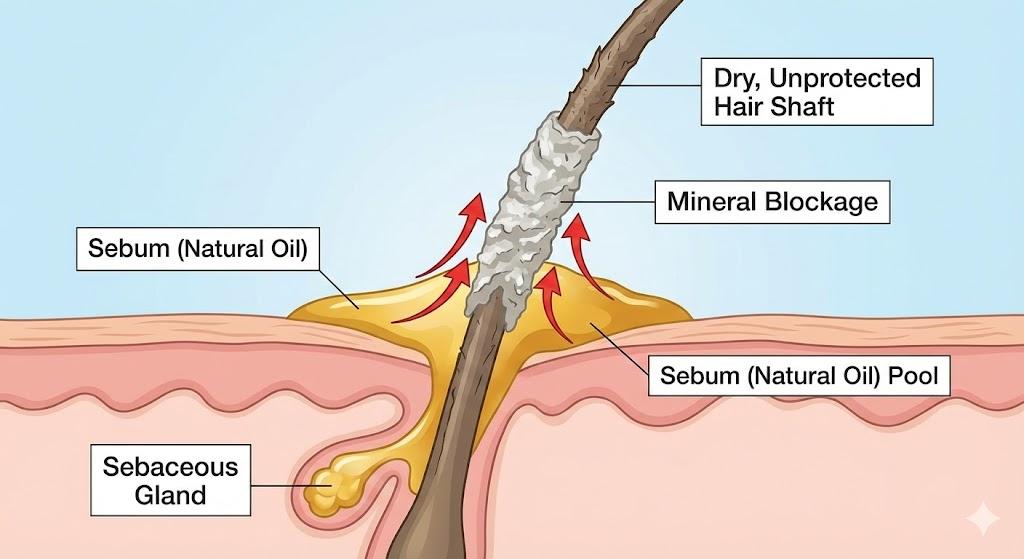
Your scalp's sebaceous glands produce sebum, a natural oil designed to protect and moisturize your hair. Under normal conditions, this oil travels down the hair shaft through brushing and natural movement, distributing evenly from roots to ends. Hard water disrupts this essential process by creating a rough, uneven surface on the hair that prevents oil migration.
The result is a paradoxical oily scalp with dehydrated lengths: roots become increasingly oily as your scalp overproduces sebum in response to sensed dryness, while the lengths and ends remain parched because the protective oils cannot reach them. This creates a frustrating cycle where you need to wash more frequently to address the greasiness, which strips away protective oils and deposits more minerals, making the problem progressively worse.
LINK2For an in-depth exploration of these damage mechanisms and why they create such contradictory symptoms, read our detailed scientific breakdown: How Hard Water Damages Hair (And Why It Feels Dry & Greasy at the Same Time)
Common Symptoms of Hard Water Hair Damage
Hard water creates a distinctive constellation of symptoms that worsen progressively over time. Recognizing these signs helps differentiate mineral damage from other hair issues like heat damage, chemical processing, or nutritional deficiencies.
Hair Fall and Thinning
While hard water doesn't directly cause hair loss in the way that hormonal imbalances or autoimmune conditions do, it creates scalp conditions and hair weakness that increase shedding significantly. Mineral deposits clog hair follicles and irritate the scalp, disrupting the normal growth cycle. Hair weakened by cuticle damage and moisture loss breaks more easily, creating the appearance of increased hair loss even when the actual shedding rate from the follicle remains normal.
The weight of accumulated minerals can also physically strain hair follicles, particularly in people with fine or already-thinning hair. Over months and years, this chronic stress contributes to decreased hair density and slower regrowth. The inflammatory response triggered by mineral irritation on the scalp may further compromise follicle health, though research in this area is still developing.
Frizz and Texture Changes
Hard water progressively alters hair texture in ways that seem permanent but are often partially reversible once mineral deposits are removed. Naturally straight hair may develop odd bends, kinks, or waves that weren't present before. Previously defined curls become frizzy, undefined, and resistant to styling products. Wavy hair loses its pattern and becomes chaotic, responding unpredictably to humidity and styling.
These texture changes occur because lifted cuticles allow environmental moisture to penetrate irregularly, causing the hair shaft to swell unevenly. The mineral coating itself adds stiffness and weight that changes how hair naturally falls and moves. In severely damaged hair, the protein structure may be sufficiently altered that some texture change persists even after mineral removal, though this is less common than reversible changes.
Frizz becomes a constant companion regardless of humidity levels, styling products, or technique. The rough cuticle surface doesn't lie flat, creating a halo effect that makes hair look perpetually unkempt. This particular type of frizz doesn't respond well to traditional anti-frizz products because it's structural rather than just a moisture issue.
Shape and Volume Disruption
Beyond texture, hard water affects how hair holds shape and maintains volume. Hair that previously responded well to styling becomes limp and flat, refusing to hold curls, waves, or any volumizing efforts. The mineral coating weighs hair down, counteracting volumizing products and techniques. Alternatively, some hair types become stiff and unmanageably voluminous in an undesirable way, standing out rather than lying smoothly.
Styling products work less effectively or seem to build up immediately rather than providing the intended hold or texture. Hairspray becomes sticky rather than creating flexible hold. Mousse makes hair crunchy instead of bouncy. Heat styling tools seem less effective, requiring higher temperatures to achieve results, which creates additional damage.
For detailed exploration of how mineral deposits alter texture, increase frizz, and change your hair's fundamental behavior, along with specific solutions for different hair types, see Hard Water Hair Fall, Frizz & Texture Changes Explained
What Actually Fixes Hard Water Hair (And What Doesn't)
Addressing hard water damage requires a multi-faceted approach. No single product or solution works for everyone, and the most effective strategy combines several elements based on your water hardness, hair type, and current damage level.
Shampoos and Cleansers
The foundation of any hard water hair care routine is a shampoo formulated to remove mineral deposits, not just clean dirt and oil. These specialized products contain chelating agents—chemical compounds that bind to metal ions and lift them away from the hair shaft.
Chelating shampoos use ingredients like EDTA (ethylenediaminetetraacetic acid) to break the ionic bonds between minerals and hair proteins. As defined by the National Institutes of Health (NIH) database, EDTA is a chemical that binds and holds on to (chelates) minerals and metals, allowing them to be rinsed away effectively. Unlike regular clarifying shampoos, chelators specifically target mineral deposits while leaving beneficial moisture relatively intact.
Not all chelating shampoos are created equal. Professional formulations typically contain higher concentrations of active ingredients than drugstore options. Some target specific minerals like iron or calcium more effectively than others. Understanding which products actually work, how to use them correctly, and how often to apply them based on your hair type makes an enormous difference in results.
For comprehensive reviews, ingredient analysis, and specific product recommendations based on hair type and water hardness level, explore our detailed guide: Shampoos That Actually Work for Hard Water Hair
Metal detox shampoos represent a newer category specifically marketed for removing mineral buildup, particularly from color-treated hair where metals can oxidize and cause unwanted tones. These formulas often include additional protecting ingredients beyond standard chelators, though the core mechanism remains similar. Whether the premium price justifies the additional benefits depends on your specific situation and hair needs.
To understand the real differences between metal detox formulas and traditional chelating shampoos, including whether the investment is worthwhile for your situation, see Metal Detox Shampoo vs Regular Shampoo: Is It Worth It?
Rinses, Clarifying Treatments, and Washing Frequency
Beyond specialized shampoos, several rinse and clarifying treatments can support mineral removal or prevent redeposition. Apple cider vinegar rinses have gained popularity for their acidic pH that helps dissolve mineral deposits and smooth the cuticle. However, the effectiveness varies based on concentration, application method, and water hardness level. Used incorrectly, ACV can dry out hair or provide minimal benefit.
Clarifying treatments, baking soda rinses, and commercial mineral-removing treatments each offer different benefits and drawbacks. Some work synergistically with chelating shampoos while others provide alternatives for people with sensitive scalps or specific hair types. The frequency of these treatments matters enormously—too often and you risk over-stripping; too rarely and buildup returns.
The question of how often to wash hair when dealing with hard water doesn't have a universal answer. Washing more frequently seems logical when hair feels greasy, but it accelerates mineral deposition. Washing less frequently allows buildup to accumulate and oils to become unmanageable. Finding the optimal balance requires understanding your specific water hardness, hair type, and lifestyle needs.
For evidence-based guidance on which rinses actually work, how to use clarifying treatments safely, and how to determine the right washing frequency for your situation, read ACV Rinse, Clarifying Shampoo & Frequency: What Actually Works?
Shower Filters and Water Treatment Solutions
While topical treatments address existing damage, filters and water softeners prevent new mineral deposition at the source. These solutions range from affordable inline shower filters to whole-house water softening systems, each with different capabilities, costs, and maintenance requirements.
Shower filters use various technologies to reduce mineral content, chlorine, and other contaminants. Vitamin C filters neutralize chlorine but have limited effect on hardness minerals. KDF (Kinetic Degradation Fluxion) filters use copper-zinc formulations to reduce heavy metals and some minerals. Multi-stage filters combining different media offer broader protection. However, no shower filter eliminates minerals completely—they reduce concentration rather than creating truly soft water.
The effectiveness of filters varies dramatically based on your water's baseline hardness, flow rate, filter quality, and maintenance schedule. Understanding what shower filters can and cannot do prevents disappointment and helps set realistic expectations. Some people experience significant hair improvement with filters alone, while others need to combine filtration with chelating shampoos for adequate results.
Water softeners use ion exchange to replace calcium and magnesium with sodium or potassium, actually eliminating hardness rather than just reducing it. These systems are more expensive and require installation and ongoing maintenance, but they provide comprehensive protection for hair, skin, plumbing, and appliances. Whole-house systems treat all water sources, while point-of-use systems target specific outlets.
For detailed analysis of whether shower filters genuinely improve hair health in hard water areas, which types work best, and whether the investment provides value compared to product-based solutions, see Do Shower Filters Really Help With Hair Loss & Hard Water?
Use the table below to quickly compare solutions.
| Solution | Removes Existing Minerals | Prevents New Buildup | Typical Cost | Maintenance |
|---|---|---|---|---|
| Chelating shampoo | ✅ Excellent | ⚠️ Only during use | $ ($10-30/bottle) | Repurchase every 1-3 months |
| Shower filter | ❌ No | ⚠️ Partial reduction | $$ ($25-80) | Replace cartridge every 3-6 months |
| Water softener | ❌ No | ✅ Eliminates hardness | $$$ ($400-2500+) | Salt/maintenance yearly |
| ACV rinse | ⚠️ Minimal | ❌ No | $ (<$5) | None (DIY) |
| Metal detox treatment | ✅ Good | ❌ No | $$ ($30-50) | Occasional use |
Complete Hair Care Routine for Hard Water Areas
Successfully managing hard water hair requires a consistent, strategic routine rather than random product application. The key is balancing mineral removal with moisture retention while preventing new buildup.
Core Wash Day Steps
Chelating shampoo application: Wet hair thoroughly with warm water. Apply chelating shampoo directly to the scalp, massaging in circular motions for 1-2 minutes. Allow it to remain on hair for an additional 1-2 minutes before rinsing—contact time matters for mineral removal. For heavily coated hair, a second shampooing may be necessary.
Deep conditioning: Apply a moisture-rich conditioner or mask from mid-lengths to ends, avoiding roots unless your scalp is extremely dry. Leave on for 3-5 minutes minimum. This is when conditioning products can actually penetrate now that the mineral barrier is removed.
Cool rinse: Finish with the coolest water you can tolerate for a final rinse. This helps seal the cuticle and lock in moisture.
Optional acidic rinse: After conditioning, a diluted apple cider vinegar rinse (1-2 tablespoons per cup of water) can further smooth the cuticle. Don't rinse it out.
Between Washes
Use dry shampoo at roots only to absorb excess oil on non-wash days. If ends feel dry, apply a small amount of leave-in conditioner or hair oil to lengths only—products work more effectively now that mineral coating is reduced.
Frequency Guidelines
Moderately hard water (61-120 ppm): Chelating shampoo once per week, deep conditioning every wash
Hard water (121-180 ppm): Chelating shampoo twice per week, intensive conditioning weekly
Very hard water (>180 ppm): Chelating shampoo 2-3 times per week, consider adding a shower filter
These are starting points—adjust based on how your hair responds. For a comprehensive, customizable routine based on your specific hair type and water hardness, explore Best Hair Care Routine for People Living in Hard Water Areas
Extreme Hard Water Situations
Some living situations present particularly challenging hard water conditions that require specialized approaches beyond standard solutions.
College dorms often have extreme hardness due to aging infrastructure and high demand. Students need portable solutions like travel-sized chelating shampoos and handheld shower filters that can be installed and removed without permanent modifications.
Apartment and rental limitations prevent installing whole-house systems. Renters need removable solutions like shower filters that attach without tools and product-based routines that compensate for untreated water.
Well water challenges often mean dramatically higher mineral content than municipal supplies, sometimes exceeding 300-400 ppm. Well owners may need whole-house treatment for acceptable results, and regular water testing helps understand what minerals you're dealing with.
Temporary housing and travel situations don't justify expensive installations. Portable shower filters, concentrated chelating shampoos in travel sizes, and quick-acting clarifying treatments work best for short-term stays.
For detailed strategies and product recommendations for these challenging situations, see Dorms, Apartments & Well Water: How to Survive Extreme Hard Water
When Fixes Go Wrong
Sometimes well-intentioned solutions create new problems or don't deliver expected results. Understanding common issues helps you adjust effectively.
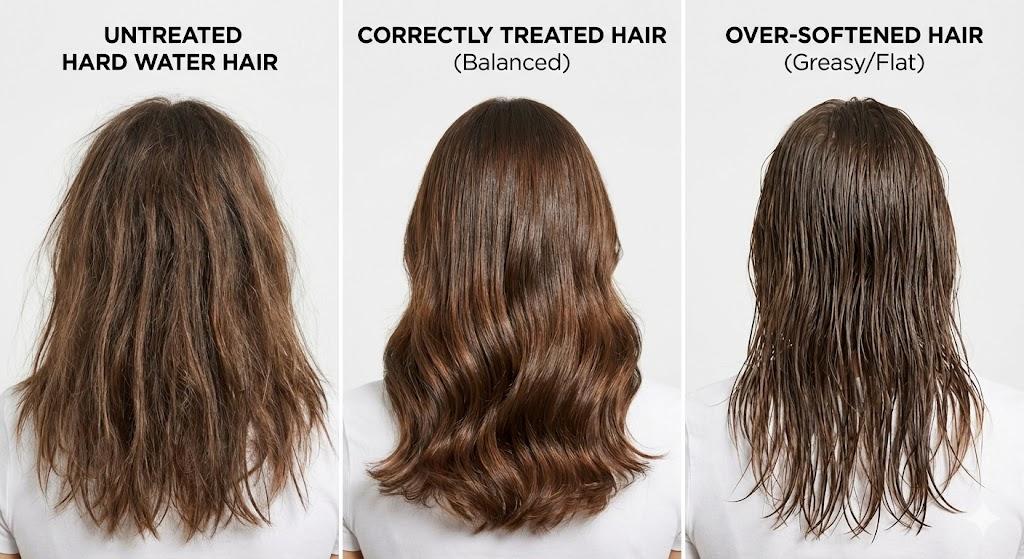
Greasy, flat hair after installing a water softener is a common complaint. Soft water removes texture-providing minerals, making fine hair limp. Years of heavy products and infrequent washing don't suit soft water. The solution isn't removing the softener but switching to lighter products, washing more frequently, and allowing your scalp's oil production to adjust.
Hair feels different but not better after installing a filter often means the filter reduces but doesn't eliminate minerals sufficiently. You still need chelating shampoos to remove existing buildup, and depending on remaining hardness, regular use even with a filter. Some filters are also simply ineffective—low quality, incorrect type, or expired cartridges.
Products still don't work despite chelating shampoo may indicate insufficient contact time, inadequate formula concentration for your water hardness, or immediate redeposition from rinsing with hard water. Severely damaged hair may also need protein reconstruction beyond mineral removal.
For comprehensive troubleshooting of these problems, including how to identify what went wrong and fix it, explore Water Softeners Made My Hair Greasy — What Went Wrong?
Frequently Asked Questions
Final Takeaway
Hard water hair damage isn't a personal failing or a sign that you need more expensive products. It's a chemical problem with straightforward solutions once you understand what you're dealing with. The minerals in your water are creating deposits that prevent your hair care routine from working, trigger your scalp to overproduce oil, disrupt your hair's structure, and make daily styling frustrating.
The solution isn't a single miracle product but a strategic combination of mineral removal, prevention, and restoration tailored to your specific water hardness, hair type, and lifestyle. Some people achieve excellent results with chelating shampoos alone. Others need shower filters or water softeners to reduce mineral exposure at the source. Many find that the best approach combines multiple strategies—removing existing buildup while preventing new deposits and supporting hair recovery with proper conditioning and protection.
What matters most is consistent action based on accurate understanding. You now know how to diagnose hard water damage, recognize the symptoms affecting your hair, choose effective solutions, and avoid the common mistakes that prevent treatments from working. You understand that the dry-yet-greasy paradox, the loss of shine, the persistent frizz, and the product resistance all stem from the same root cause—and that cause is addressable.
Start by removing the buildup that's currently coating your hair. Use a proper chelating shampoo with the right technique and frequency for your water hardness. Give it three to four weeks of consistent use to see meaningful results. Then evaluate whether additional measures like shower filters or water treatment would provide added benefit.
Your hair's transformation won't happen overnight, but with the right approach, it will happen. The hair you wash next month can look and feel fundamentally different than the hair you're dealing with today—lighter, shinier, more manageable, and finally responding to the products and care you've been trying to give it all along.
The problem was never your hair. It was the water. Now you know how to fix it.
If you want to start fixing the issue, removing buildup is the logical first step.