If your hair feels squeaky-clean right after washing, yet greasy and heavy by the next day, you're not imagining things. Many people experience this confusing cycle where their hair seems simultaneously dry and oily, stiff yet weighed down, clean but somehow dirty-looking within hours.
You've probably switched shampoos multiple times, tried clarifying treatments, adjusted your washing frequency, and still can't figure out why your hair won't cooperate. The frustration is real, and the problem might not be your routine at all.
Table of Contents
- How to Tell If Hard Water Is Actually Damaging Your Hair?
- What Is Hard Water?
- How Hard Water Actually Damages Hair
- The "Dry but Greasy" Paradox
- The Invisible Coating Most People Don’t Realize Is There
- Why Regular Shampoo Can’t Remove Hard Water Damage
- Common Signs of Damage
- What NOT to Do
- The Real Solution Starts With Removing the Barrier
- Long-Term Effects
- Final Thoughts
How to Tell If Hard Water Is Actually Damaging Your Hair
Many people blame their shampoo, hormones, or even genetics when their hair suddenly changes. In reality, hard water damage follows a very specific and recognizable pattern.
- Your hair feels clean after washing but still looks dull or lifeless
- Your roots get oily within hours, while your ends stay dry and brittle
- Conditioner feels like it “stopped working” no matter how much you use
- Your hair feels rough or coated when wet, not smooth
- Hair color fades faster or turns brassy sooner than expected
- Frizz increases even though you’re using moisturizing products
If several of these sound familiar, the issue likely isn’t your products — it’s mineral buildup from hard water creating a barrier on your hair.
What Is Hard Water?
Hard water contains high concentrations of dissolved minerals, primarily calcium and magnesium. These minerals accumulate as water passes through limestone, chalk, and gypsum deposits before reaching your home.
Unlike soft water, which rinses cleanly, hard water leaves behind a residue that affects everything it touches—from your shower doors to your hair. The severity varies by location, but in places like Southern California, the water is notoriously hard.
How Hard Water Actually Damages Hair
1. Mineral Buildup on Hair Shaft
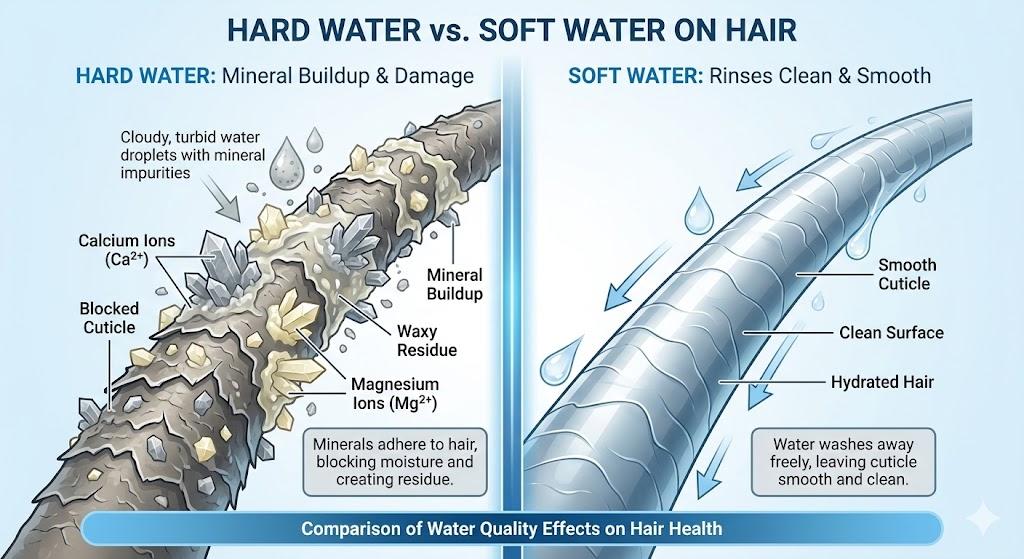
When hard water flows over your hair, calcium and magnesium ions attach themselves to the hair shaft surface. Unlike dirt or product residue that can be washed away, these minerals form a stubborn film that bonds with the hair's keratin structure. Each wash adds another microscopic layer, creating an accumulation that thickens over time.
This mineral coating doesn't respond to regular shampoo because it's not oil-based. The result is a persistent layer that makes your hair feel coated, rough, or strangely textured even immediately after washing.
2. Why Regular Shampoo Can't Remove It
Standard shampoos rely on surfactants that are formulated to dissolve oils and dirt, not chemical mineral deposits. To actually remove hard water deposits, you need chelating agents like EDTA or citric acid that can bind to metal ions and lift them away from the hair shaft.
3. Cuticle Disruption
Healthy hair has a smooth cuticle layer with overlapping scales that lie flat. Hard water disrupts this structure by causing the cuticle scales to lift and remain open. The mineral deposits wedge themselves between these scales, preventing them from closing properly.
When cuticles stay raised, moisture escapes more easily, leading to genuine dryness. Light no longer reflects smoothly, so your hair loses its shine. This explains why hard water-affected hair often feels brittle and coarse.
The "Dry but Greasy" Paradox
This seemingly contradictory condition is one of the most telltale signs of hard water damage. Here is exactly why it happens:
- Blocked Oils: The mineral buildup creates a rough surface that prevents your natural scalp oils (sebum) from traveling down the hair shaft. The oil gets trapped at the roots.
- Moisture Blockade: Meanwhile, the lengths and ends of your hair remain dry because the mineral coating blocks moisture from penetrating.
- Scalp Panic: Your scalp senses the dryness and responds by producing more oil to compensate.
The result? Hair that feels heavy and greasy at the scalp within hours of washing, while looking frizzy and dry at the ends.
The Invisible Coating Most People Don’t Realize Is There
Think of hard water minerals like an invisible layer of cement dust settling on your hair with every wash. You can’t see it, but you can feel its effects over time.
Calcium and magnesium bind directly to the hair’s keratin structure. Once attached, they don’t simply rinse away. Instead, they accumulate layer after layer, slowly sealing the hair cuticle and blocking moisture from entering.
This is why hair exposed to hard water can feel paradoxical — greasy at the roots but dry along the lengths. Oils get trapped near the scalp, while the ends are deprived of hydration.
Why Regular Shampoo Can’t Remove Hard Water Damage
Most shampoos are designed to remove oil and dirt — not minerals.
Hard water minerals don’t behave like grease. They form ionic bonds with the hair shaft, which means traditional surfactants simply glide over them instead of breaking them down.
This is why switching shampoos rarely fixes the problem. You may notice temporary improvement, but the mineral layer remains underneath, preventing conditioners and treatments from working properly.
To actually address hard water damage, mineral buildup must be dissolved or chelated — not scrubbed away.
Stop the Buildup Cycle
In our salon, we use professional chelating treatments to safely remove mineral buildup. For home care, we recommend sulfate-free shampoos with chelating agents.
See Proven Hard Water ShampoosCommon Signs Your Hair Is Damaged by Hard Water
Recognizing hard water damage isn't always obvious. Here are the reliable indicators:
- Waxy Feeling: Hair feels coated even after thorough washing.
- No Lather: Shampoo doesn't foam up well despite using plenty of product.
- Stiff Drying: Hair dries stiff or "squeaky" rather than soft.
- Fading Color: Hair color fades faster or turns brassy/orange (common in blondes).
- Itchy Scalp: Increased dandruff or flaking due to mineral irritation.
What NOT to Do
When faced with dry-yet-greasy hair, avoid these common mistakes that make things worse:
- Over-washing: Washing daily strips protective oils and deposits more minerals with every rinse.
- Using Heavy Oils: Oils cannot penetrate the mineral barrier; they just sit on top and make hair greasier.
- Switching Shampoos Randomly: Buying more "moisturizing" shampoos won't help if they don't have chelating ingredients.
- Skipping Conditioner: This leaves your lifted cuticles unprotected and prone to breakage.
The Real Solution Starts With Removing the Barrier
Before adding more moisture, protein, or expensive treatments, the mineral layer needs to be addressed first.
Once buildup is removed, hair often responds dramatically — softness returns, frizz decreases, and products suddenly “start working again.”
This is why routines designed specifically for hard water conditions are far more effective than generic hair care advice. You can explore a step-by-step routine here: Best Hair Care Routine for People Living in Hard Water Areas.
When This Becomes a Long-Term Problem
Short-term exposure is annoying, but chronic exposure leads to cumulative damage:
- Progressive Thinning: Buildup can weigh down follicles and disrupt the growth cycle.
- Increased Breakage: Weakened hair snaps mid-strand during styling.
- Permanent Texture Changes: Wavy hair may become frizzy and undefined; straight hair may develop odd kinks.
- Chemical Failure: Color and chemical treatments (like keratin) may fail or process unevenly because of the mineral barrier.
Frequently Asked Questions About Hard Water Damage
Final Thoughts
Hard water damage isn’t caused by neglect or bad products — it’s caused by an invisible mineral barrier that most people don’t realize is there.
Once you understand why hair can feel dry and greasy at the same time, the frustration finally makes sense. The solution isn’t adding more moisture — it’s removing what’s blocking it.
If you suspect hard water is affecting your hair, start by learning how mineral buildup forms, then move toward targeted solutions designed specifically for hard water environments.
For a complete breakdown of causes, symptoms, and proven fixes, visit our main guide: Hard Water Is Ruining Your Hair: Causes, Symptoms & Proven Fixes.