Introduction
You've noticed more hair in your brush lately. Your once-smooth hair now feels rough and unmanageable. The frizz seems relentless no matter which products you try. Your hair's texture has changed so much that you barely recognize it—straight hair has become coarse and wiry, or your curls have lost all definition and turned into a frizzy mess.
These changes didn't happen overnight, but they've been progressive and persistent. You might suspect hard water is involved, but the questions pile up: Is hard water actually making you lose hair? Can mineral buildup really change your hair's fundamental texture? And most importantly, is this damage permanent, or can you restore your hair to what it used to be?
The relationship between hard water and these visible hair problems is more direct than many people realize, yet also more nuanced than the simple cause-and-effect most articles describe. Understanding exactly how mineral deposits trigger hair fall, create frizz, and alter texture helps you address the root cause rather than just treating symptoms.
This guide breaks down the mechanisms behind hard water's most visible effects on hair, distinguishes between different types of hair problems, and provides clarity on what can actually be reversed versus what requires different intervention.
Table of Contents
- Introduction
- Why Hard Water Changes the Way Your Hair Looks and Feels
- Hair Fall vs. Breakage: Is Hard Water Making You Go Bald?
- Why Hard Water Makes Hair Frizzy and Unmanageable
- Texture Changes: Why Your Hair Doesn't Feel Like It Used To
- Why All These Problems Feel Random (But Aren’t)
- The Role of Buildup: The Real Villain
- The 2-Week Fix: Can You Reverse Hard Water Damage?
- When You Should Consider a Shower Filter
- Frequently Asked Questions
- Conclusion
Why Hard Water Changes the Way Your Hair Looks and Feels
Hard water doesn't create a single isolated problem—it triggers a cascade of interconnected changes that affect every aspect of your hair's appearance and behavior.
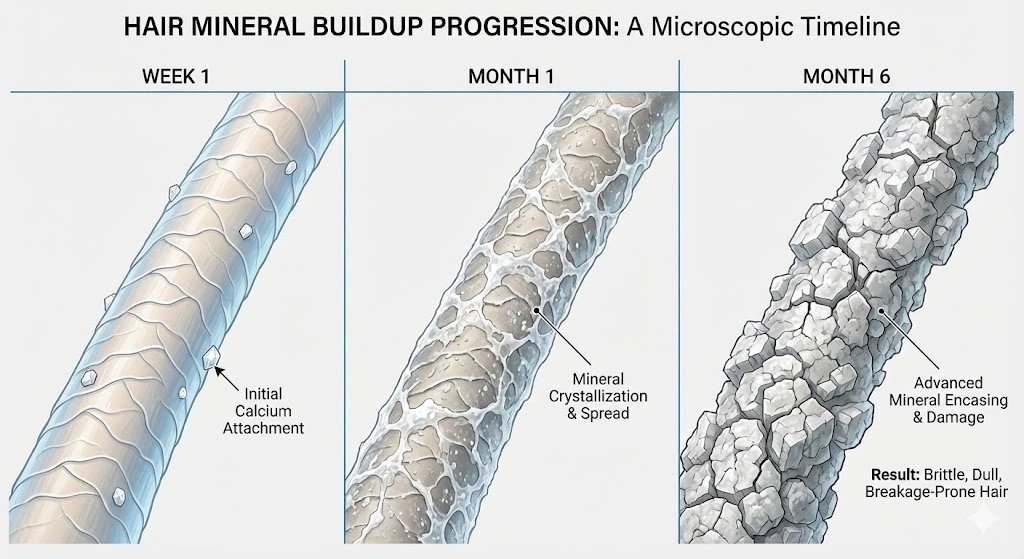
The foundation of all hard water damage is mineral buildup. Every time you wash your hair with hard water, calcium and magnesium ions bond to the keratin proteins in your hair shaft. These deposits accumulate in layers, creating a coating that becomes progressively thicker with each exposure. Unlike dirt or product residue that rinses away, these minerals form ionic bonds that resist removal by regular shampooing.
This buildup doesn't just sit passively on your hair—it actively disrupts normal hair function. The mineral layer blocks moisture from penetrating the hair shaft, leaving the internal structure dehydrated despite surface coating. It prevents conditioning ingredients from working, creates rough texture, and interferes with your hair's natural flexibility and movement.
The feeling of "different" hair develops gradually. Initially, you might notice your hair doesn't rinse as cleanly or feels slightly coated after washing. Over weeks and months, the texture becomes noticeably rougher. Hair that used to air-dry smooth now dries with frizz and flyaways. Products that previously worked well seem to stop being effective. Your hair takes longer to dry, feels heavier, and resists styling in ways it never did before.
These aren't separate issues requiring separate solutions—they're all manifestations of the same underlying problem: mineral deposits altering your hair's physical and chemical properties. Understanding this connection is crucial because treating individual symptoms without addressing buildup provides only temporary, superficial improvement.
Hair Fall vs. Breakage: Is Hard Water Making You Go Bald?
This is perhaps the most anxiety-inducing question about hard water, and the answer requires careful distinction between different types of hair loss.
Hair Fall vs Hair Loss: A Critical Difference
Hair fall (or shedding) refers to hair naturally completing its growth cycle and detaching from the follicle. Everyone loses 50-100 hairs per day as part of normal turnover. This hair falls out with the root bulb attached—you can see the small white bulb at the end if you examine shed hairs closely.
Hair loss (alopecia) occurs when follicles stop producing hair normally due to genetic factors, hormonal imbalances, autoimmune conditions, or medical issues. This represents actual reduction in hair density from the scalp rather than just increased shedding.
The crucial point: Hard water does not cause permanent hair loss or follicle damage. It doesn't trigger male or female pattern baldness, doesn't create bald spots, and doesn't permanently stop hair growth. If you're experiencing these patterns, hard water may be aggravating the condition, but it's not the primary cause—you should consult a healthcare provider for proper diagnosis.
How Hard Water Causes Apparent Hair Fall
While hard water doesn't damage follicles, it creates conditions that significantly increase visible shedding and create the appearance of hair loss through several mechanisms:
- Scalp buildup and follicle interference: Mineral deposits accumulate not just on hair strands but on the scalp surface and around follicle openings. This buildup can partially obstruct follicles, interfering with the normal growth cycle and weakening hair as it emerges. While this doesn't kill the follicle, it can push more hairs prematurely into the telogen (resting) phase before shedding.
- Chronic low-grade inflammation: The scalp reacts to persistent mineral coating with mild inflammatory response. The skin becomes irritated, tight, itchy, or flaky. This chronic inflammation creates an inhospitable environment for healthy hair growth and can disrupt the anagen (growth) phase, leading to increased shedding.
- Hair breakage mistaken for hair loss: This is the most significant factor. Hard water severely weakens hair structure through cuticle damage and moisture depletion. Weakened hair breaks off along the shaft rather than falling out from the root. When you see hair in your brush, shower drain, or on your pillow, much of it is broken pieces rather than naturally shed complete hairs. The cumulative effect creates the appearance of dramatic hair loss even though your follicles are still producing hair normally.
- Increased mechanical stress: Mineral-coated hair tangles more easily, creating knots that require forceful brushing to detangle. The rough texture increases friction between strands. Both factors lead to mechanical breakage during normal grooming, compounding the problem.
The distinction matters enormously for treatment. If hard water is causing increased shedding and breakage, addressing the mineral buildup can restore normal hair retention within weeks to months. If you have underlying hair loss from other causes, removing hard water damage helps but won't solve the primary problem.
For detailed exploration of how water filtration addresses these specific issues, see Do Shower Filters Really Help With Hair Loss & Hard Water?
Why Hard Water Makes Hair Frizzy and Unmanageable
Frizz isn't just an aesthetic annoyance—it's a visible sign of structural damage to the hair cuticle, and hard water is one of the most consistent triggers for progressive frizz development.
Mineral Buildup + Open Cuticle = Persistent Frizz
Healthy hair has a smooth outer cuticle layer composed of overlapping scales that lie flat against the hair shaft, similar to roof shingles. When these scales remain closed, hair appears shiny, feels smooth, and resists humidity-induced frizz. Hard water disrupts this structure through a specific mechanism:
Cuticle lifting: Calcium and magnesium deposits wedge themselves between cuticle scales, forcing them to lift and remain in an open position. The minerals physically prevent the scales from lying flat even after conditioning treatments that would normally smooth the cuticle.
Surface roughness: The mineral coating itself creates an uneven, rough surface texture. Instead of smooth strands that glide past each other, you have textured, grabby hair that catches and tangles. This rough surface scatters light diffusely rather than reflecting it smoothly, creating dull appearance alongside the frizz.
Moisture imbalance: Open cuticles allow internal moisture to escape while simultaneously allowing environmental moisture to penetrate irregularly. In humid conditions, the damaged areas of the hair shaft absorb atmospheric moisture unevenly, causing the hair to swell in some spots more than others. This irregular swelling is what creates the frizzy, undefined appearance.
Loss of natural smoothing: Your scalp's natural sebum is designed to coat hair and create water resistance that prevents humidity absorption. Hard water blocks this oil from distributing properly, removing your hair's natural frizz defense while simultaneously creating structural vulnerability to environmental moisture.
The result is hair that becomes progressively more frizzy over time, especially in humid environments. You might notice that your hair used to handle humidity well but now frizzes immediately upon exposure. This isn't because the climate changed—it's because accumulated mineral damage has destroyed your hair's structural defenses against moisture.
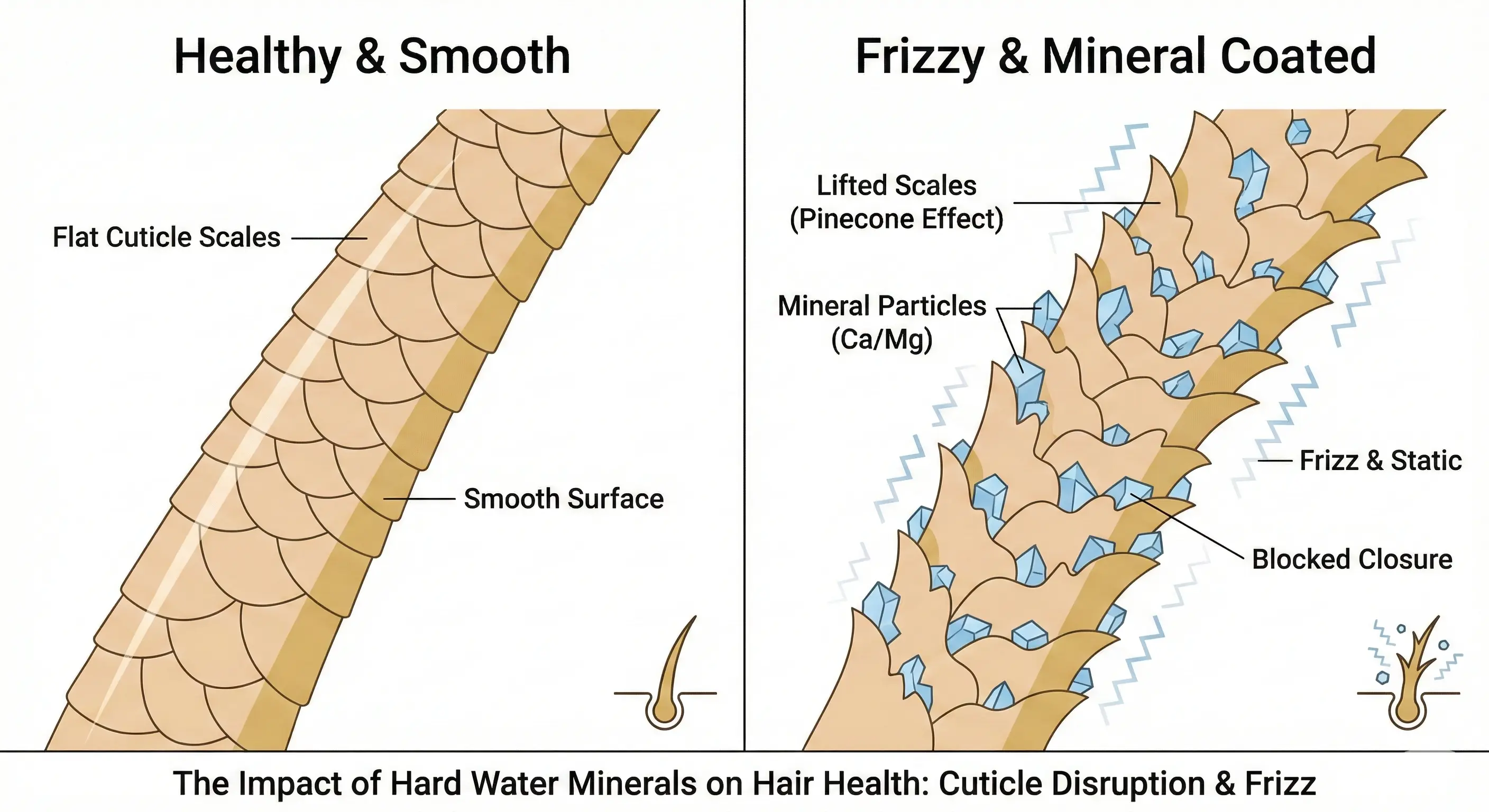
The frizz created by hard water resists typical anti-frizz products because those products can't penetrate the mineral barrier to smooth the cuticle or can't override the physical obstruction preventing scales from closing. This explains why switching frizz serums or smoothing treatments provides minimal improvement—the underlying structural problem remains unaddressed.
Texture Changes: Why Your Hair Doesn't Feel Like It Used To
Beyond frizz and shedding, hard water creates fundamental alterations in how hair looks, feels, and behaves. These texture changes often develop so gradually that you don't pinpoint when they started, but the cumulative effect is undeniable.
Straight Hair Becomes Rough and Coarse
If you have naturally straight hair, hard water progressively transforms smooth, sleek strands into rough, wiry texture. The hair loses its natural slip—strands don't glide smoothly when you run your fingers through, and brushing creates more resistance and static. The straight pattern may remain, but the surface texture becomes harsh and unrefined.
This coarsening happens because the mineral coating adds texture where none existed naturally. Your hair shafts become thicker from the accumulated deposits, though this thickness is unhealthy buildup rather than genuine hair strength. The rough surface creates friction between strands, making hair feel stiff and uncooperative during styling.
Curly Hair Loses Definition and Pattern
For naturally curly or coily hair, hard water wreaks particularly noticeable havoc. Well-defined curl patterns become frizzy, undefined, and inconsistent. Curls that once formed predictable spirals or coils now appear shapeless, stringy, or create awkward bends rather than smooth curves.
The mechanism is specific to curl structure. Curly hair is naturally more porous than straight hair, absorbing minerals more readily and suffering greater cumulative damage. The weight of mineral buildup pulls curls straighter, reducing bounce and spring. The cuticle damage prevents curls from forming their natural hydrogen bonds that create and maintain curl pattern. Moisture blockage—critical for curl definition—leaves curls dry, frizzy, and unable to maintain shape.
Many people with textured hair find that their curl pattern seems to change completely in hard water areas, with some sections becoming looser while others tighten unpredictably. This isn't the hair's natural pattern changing—it's uneven mineral distribution and damage creating artificial texture variations.
Wavy Hair Becomes Unpredictable
Wavy hair occupies a particularly frustrating middle ground. Hard water can either pull waves straighter through buildup weight or increase frizz so dramatically that waves become undefined chaos. Day-to-day consistency disappears—hair that waved beautifully yesterday looks flat and stringy today, or vice versa.
This unpredictability stems from how buildup affects wave formation. Waves depend on controlled moisture distribution and cuticle behavior to form consistent patterns. Hard water disrupts both, making wave formation random and difficult to predict or style consistently.
The Common Thread: Coated, Unresponsive Hair
Across all hair types, the universal complaint is that hair feels coated. There's an invisible film you can almost sense with your fingers. Products sit on the surface rather than being absorbed. Styling doesn't hold. The hair has lost its natural responsiveness and feels disconnected from the care you're providing.
This coated sensation is the most reliable indicator of mineral buildup and often persists even when you switch to supposedly better products. The problem isn't product quality—it's the barrier preventing any product from reaching your hair.
For comprehensive understanding of how these damage mechanisms create the contradictory "dry yet greasy" sensation alongside texture changes, explore How Hard Water Damages Hair (And Why It Feels Dry & Greasy at the Same Time).
Why All These Problems Feel Random (But Aren’t)
Hair fall, frizz, dryness, texture changes — they often feel like separate, unrelated problems. Many people blame aging, hormones, stress, or “bad hair genetics.” In reality, when hard water is involved, these symptoms usually come from the same source.
Mineral buildup coats the hair shaft unevenly. On some strands it causes breakage, on others it blocks moisture, and on the scalp it disrupts oil balance. The result looks chaotic — but the cause is consistent.
This is why switching shampoos randomly rarely works. Until mineral deposits are removed, every product behaves differently than intended.
If this sounds exactly like your hair, the next step isn’t buying another random shampoo — it’s removing mineral buildup first.
Learn how chelating shampoos remove hard water minerals and why regular shampoos fail in hard water environments.
The Role of Buildup: The Real Villain
While we've discussed mineral deposits throughout this guide, understanding why standard hair care fails against buildup clarifies why specialized approaches are necessary.
Why regular shampoo can't remove minerals: Standard shampoos use surfactants designed to dissolve oils and remove dirt through emulsification. These cleansing agents work brilliantly on sebum, styling products, and environmental pollutants—all organic, oil-based substances. But calcium and magnesium form ionic bonds with hair proteins through a completely different mechanism. Oil-dissolving surfactants can't break these mineral-to-protein connections.
This is why you can shampoo repeatedly, use clarifying formulas, and still feel the coating. You're removing surface oils and some loose deposits, but the bonded mineral layer remains intact. Each wash actually adds a fresh layer of minerals on top of existing buildup, progressively worsening the problem even as you try to clean your hair.
The chelating solution: Removing mineral buildup requires chelating agents—specialized ingredients like EDTA (ethylenediaminetetraacetic acid), citric acid, or phytic acid that form complexes with metal ions. These agents literally grab onto calcium and magnesium, breaking their bonds with hair proteins and allowing them to be rinsed away.
Chelating shampoos aren't just "stronger" cleansers—they use fundamentally different chemistry targeting the specific problem regular shampoos can't address. This is why switching between different regular shampoo brands provides no improvement, while a single use of proper chelating shampoo creates noticeable difference.
Frequency and maintenance: Even with chelating treatments, buildup returns because you continue washing with hard water. The treatment removes existing deposits, but new minerals start accumulating immediately. Most people need chelating treatments every one to three weeks depending on water hardness and hair porosity.
For specific guidance on clarifying frequency, apple cider vinegar rinses, and how to incorporate chelating treatments into your routine effectively, see ACV Rinse, Clarifying Shampoo & Frequency: What Actually Works?.
The specialized chemistry needed to remove hard water deposits is precisely why chelating shampoos remove minerals far more effectively than any amount of regular clarifying or deep-cleansing treatments.
The 2-Week Fix: Can You Reverse Hard Water Damage?
This is where we transition from understanding the problem to addressing the psychological weight it creates. If months or years of exposure have damaged your hair, is it too late? Can you restore what you've lost?
The encouraging answer: Yes, in most cases, hard water damage is largely reversible.
The timeline and extent of recovery depend on current damage severity, but the fundamental principle is sound—once you remove mineral buildup and prevent new accumulation, your hair can recover substantially.
What Improves Quickly (1-2 Weeks)
- Scalp comfort: Irritation, itching, and tightness typically resolve within one to two weeks once mineral deposits are removed from the scalp surface. The inflammatory response calms quickly when the irritant is eliminated.
- Product effectiveness: Once the mineral barrier is removed, conditioners, treatments, and styling products can actually penetrate and work. You'll notice immediate improvement in how products perform—conditioner makes hair feel softer, serums add shine, and styling products provide hold.
- Manageability: Hair becomes easier to detangle and style within days as the rough coating is removed and cuticles begin to lie flatter.
What Improves Gradually (2-4 Weeks)
- Frizz reduction: As the cuticle repairs and moisture balance is restored, frizz decreases progressively. Hair regains some ability to repel environmental humidity and maintain smooth appearance.
- Texture restoration: Your natural hair texture begins to reassert itself as mineral weight is removed and cuticle health improves. Curls regain some definition, straight hair becomes smoother, waves return to more predictable patterns.
- Apparent hair fall reduction: As breakage decreases and hair strength improves, you'll notice less hair in your brush and shower drain. This reduction becomes evident within two to four weeks of consistent treatment.
What Requires Longer (1-3 Months)
- Complete texture normalization: Severely damaged sections may take weeks to months to fully recover as new, healthy hair grows and replaces damaged lengths.
- Rebuilding hair strength: Hair weakened by prolonged mineral exposure needs time to regain tensile strength and elasticity through proper conditioning and protein treatments.
- Restoring shine and luster: Deep shine returns as cuticle health fully restores and hair regains its ability to reflect light smoothly.
The Essential Conditions for Recovery
Recovery isn't automatic—it requires consistent action:
- Remove existing buildup completely using appropriate chelating treatments rather than hoping it will gradually wash away.
- Prevent new buildup through shower filters, water softeners, or continued regular use of chelating products.
- Support repair with appropriate conditioning, moisture treatments, and in some cases protein treatments to rebuild damaged structure.
- Be patient through the recovery period rather than switching products constantly or expecting overnight transformation.
For a complete, structured approach to recovery that addresses each phase of damage reversal, explore Best Hair Care Routine for People Living in Hard Water Areas.
When You Should Consider a Shower Filter
Shower filters occupy a specific role in addressing hard water damage—they're preventive rather than curative, and their value depends on your situation's severity.
When filters provide meaningful benefit:
- If you have mild to moderate hard water (60-180 ppm), a quality multi-stage shower filter can reduce mineral content enough to significantly slow buildup accumulation. Combined with periodic chelating treatments, this creates a maintainable long-term solution.
- If scalp irritation is prominent, filters remove chlorine and reduce minerals that irritate sensitive skin, often providing noticeable comfort improvement within days.
- If you're maintaining recovered hair, a filter helps protect the progress you've made through chelating treatments by reducing new deposit formation.
When filters aren't sufficient alone:
- If you have very hard or extremely hard water (>180 ppm), shower filters reduce but don't eliminate minerals. You'll still need regular chelating treatments, and the filter primarily extends time between treatments rather than eliminating the need.
- If hair is already severely damaged with months or years of buildup, the filter prevents future problems but doesn't address existing damage. Start with intensive chelating before adding filtration.
- If you're experiencing active, significant hair loss beyond normal shedding, a filter won't address underlying medical causes. It may reduce aggravating factors, but hair loss from hormonal, genetic, or autoimmune causes requires medical intervention.
The realistic perspective: Shower filters work best as one component of a comprehensive approach—reducing exposure while you actively remove existing buildup and maintain hair health. They're valuable but not miraculous, helpful but not sufficient alone for severe situations.
For detailed analysis of filter effectiveness, limitations, and how to determine whether investment makes sense for your specific water hardness and hair condition, see Do Shower Filters Really Help With Hair Loss & Hard Water?
Frequently Asked Questions
Conclusion
Hard water's effects on hair—increased shedding, persistent frizz, and altered texture—aren't mysterious or untreatable conditions. They're predictable consequences of mineral buildup creating specific types of damage: cuticle disruption, moisture blockage, and structural weakening.
Understanding the mechanisms behind these changes transforms them from frustrating mysteries into addressable problems with clear solutions. The hair fall that concerns you is primarily breakage, not permanent follicle damage. The frizz results from lifted cuticles and rough mineral coating. The texture changes reflect mineral weight and cuticle dysfunction rather than permanent alteration of your hair's fundamental structure.
Most importantly, these problems are largely reversible. With proper chelating treatments to remove existing buildup, preventive measures to reduce new deposits, and appropriate care to support hair recovery, you can restore much of what hard water has damaged. The timeline varies—some improvements appear within days, others take weeks or months—but consistent, informed action produces genuine results.
The key is understanding that standard hair care approaches fail because they're designed for different problems. Regular shampoos can't remove minerals. Standard conditioners can't penetrate mineral barriers. Typical frizz products can't overcome structural cuticle damage. You need targeted solutions that address the specific chemistry of hard water damage.
Start with removing the buildup that's currently coating your hair. Then establish a routine that prevents rapid reaccumulation while supporting your hair's recovery. Be patient through the restoration process, and trust that your hair can largely return to its natural state once the damaging mineral exposure is properly addressed.
For comprehensive guidance on the complete picture of hard water damage and how all these elements fit together, explore our detailed resource: Hard Water Is Ruining Your Hair: Causes, Symptoms & Proven Fixes