Table of Contents
Your blade is two shaves old and it's already dragging. You're spending $4–5 per cartridge and going through them faster than it makes any sense to. You've tried shaking the water off, letting it air-dry, storing it differently — and every time, the same result. A blade that felt sharp on day one feels like it's pulling hairs out by the roots on day three.
Here's what's actually happening: your blade probably isn't dull. It's coated.
Hard water does not dull stainless steel by removing metal from the cutting edge. The blade's apex — the microscopic tip that actually cuts hair — is intact. What hard water does is something more insidious: as the tap water evaporates from your razor after each shave, it leaves behind a calcified mineral film made of calcium and magnesium deposits directly on and around that cutting edge. This film is rough, irregular, and abrasive. When you shave, it's not the steel edge contacting your hair first — it's this crystallized mineral crust. It drags. It pulls. It creates the illusion of a dull blade when the blade itself is perfectly fine.
Does hard water ruin razor blades? Not through dulling in the traditional sense. It ruins the performance of an otherwise sharp blade by coating it in friction-causing mineral residue — and that distinction changes everything about how you fix it.
The fix is not buying new blades. The fix takes three seconds and costs almost nothing.
The Illusion of Dullness: What Is the White Residue on a Safety Razor?
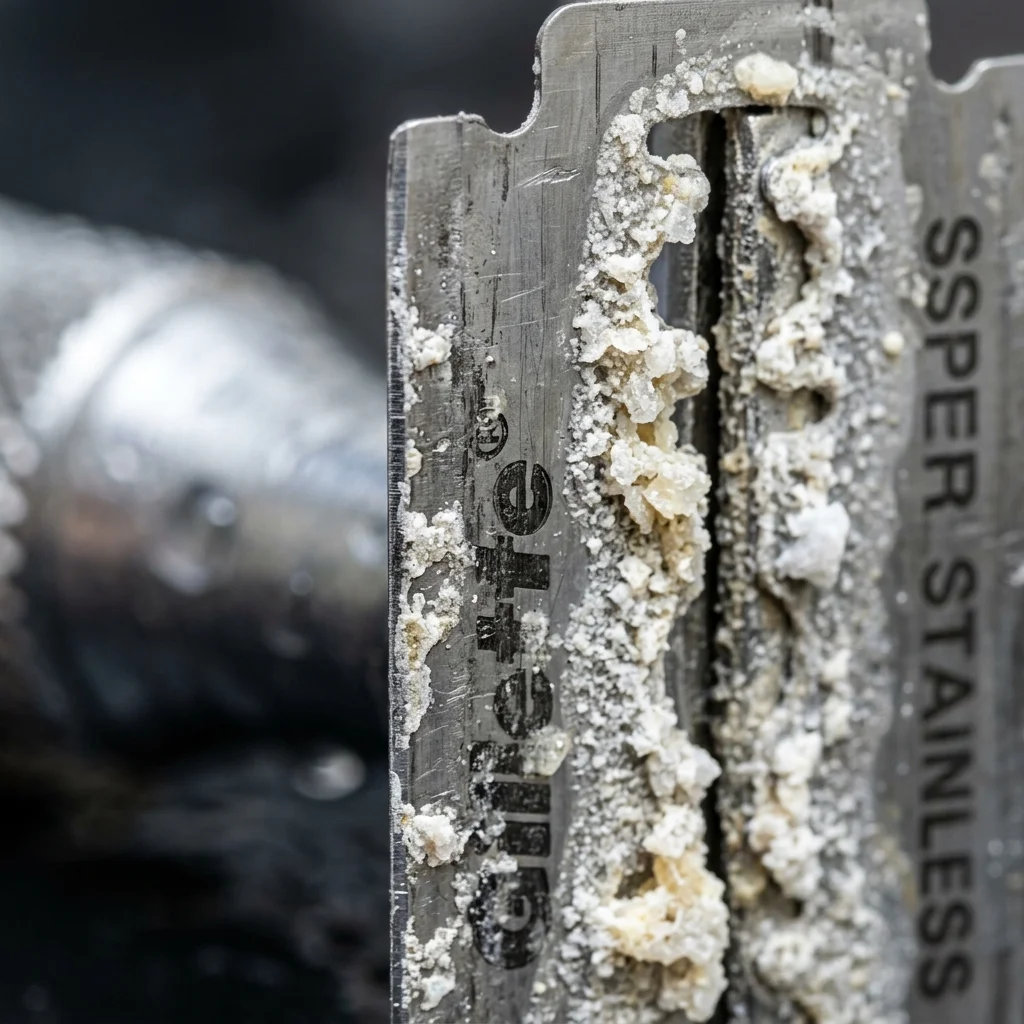
The white residue on a safety razor is not soap. It's not rust. It's not a sign that your razor is broken. It's a physical deposit of calcium carbonate and magnesium compounds — the same minerals responsible for the limescale crust on your shower head and the white ring inside your kettle — now concentrated directly on the most precision-engineered part of your grooming kit.
The Chemistry of the Coating
Every time you rinse your razor and set it down, the water clinging to the blade begins to evaporate. The water molecules leave. The minerals don't. The calcium and magnesium ions dissolved in that tap water are left behind, and as the water film thins, they bond with each other and with any soap residue still present to form insoluble calcium and magnesium soap compounds — what the chemistry world calls soap scum and what the shaving community simply calls the coating that's ruining their shave.
This process was confirmed in a 30-day controlled laboratory test using Gillette Mach3 razors. Razors exposed to hard water and left to air-dry showed visible white crystalline mineral deposits building up from as early as day 10, progressively worsening through day 30. The buildup appeared as white, crusted formations across the blade surfaces and in the gaps between blades. The control razor that received a protective rinse solution showed dramatically less buildup at every measurement point. The conclusion was unambiguous: air-drying in hard water conditions actively and measurably coats your blades.
Modern razor blades are engineered to microscopic tolerances. The cutting apex — the very tip of the blade that contacts hair — has a radius measured in nanometers, typically between 50 and 80 nanometers on a commercial blade. The blade's cutting layers include protective coatings like Diamond-Like Carbon (DLC) film, platinum, and PTFE (the "lubricating strip" coating) — all designed to produce an ultra-low friction surface that glides through hair cleanly.
A calcium carbonate crust doesn't care about any of that engineering. It bonds to the blade surface regardless of coating type and builds a rough, irregular topography over the precision-smooth cutting geometry that the manufacturer spent considerable effort creating.
The "Tea Stain" Problem
In the wet-shaving community, there is a specific term for the micro-oxidation pattern that develops around hard water mineral deposits on blade edges: tea stains. These are the faint, brownish-yellow discolorations you sometimes see on blade surfaces after several shaves — not rust in the traditional sense (modern stainless steel blades resist rust well under normal conditions), but a form of localized surface oxidation that occurs preferentially around the mineral deposit sites.
The science behind this is precise: calcium, magnesium, and chloride ions in hard water act as electrolytes. When these electrolytes contact the ultra-thin cutting edge — typically 3–5 micrometers thick at the apex — they create micro-galvanic cells that accelerate localized surface oxidation. Even without visible rust, this micro-oxidation disrupts the sub-micron smoothness of the cutting edge, creating the kind of irregular surface that feels like dragging rather than cutting.
The Mallorca Test Case
One veteran wet-shaver documented this phenomenon clearly from lived experience in Mallorca, Spain — a Mediterranean island with notoriously hard municipal water. The pattern was always the same: a visible layer of soap scum on top of the shaving water, and a white residue consistently appearing on the razor after each shave. Left unaddressed, this residue was observed to interact with the plating on the razor handle over time. This single observation contains the two distinct problems that hard water creates for razor users: the friction coating on the blade that creates the illusion of dullness, and the ongoing chemical attack on the handle's finish that causes longer-term cosmetic and structural damage.
Both problems have specific, different solutions. The blade problem is solved in seconds. The handle problem requires a monthly cleaning routine — and strict avoidance of the shortcuts that destroy plating permanently.
The 3-Second Hack: Using Rubbing Alcohol to Clean Razor Blades
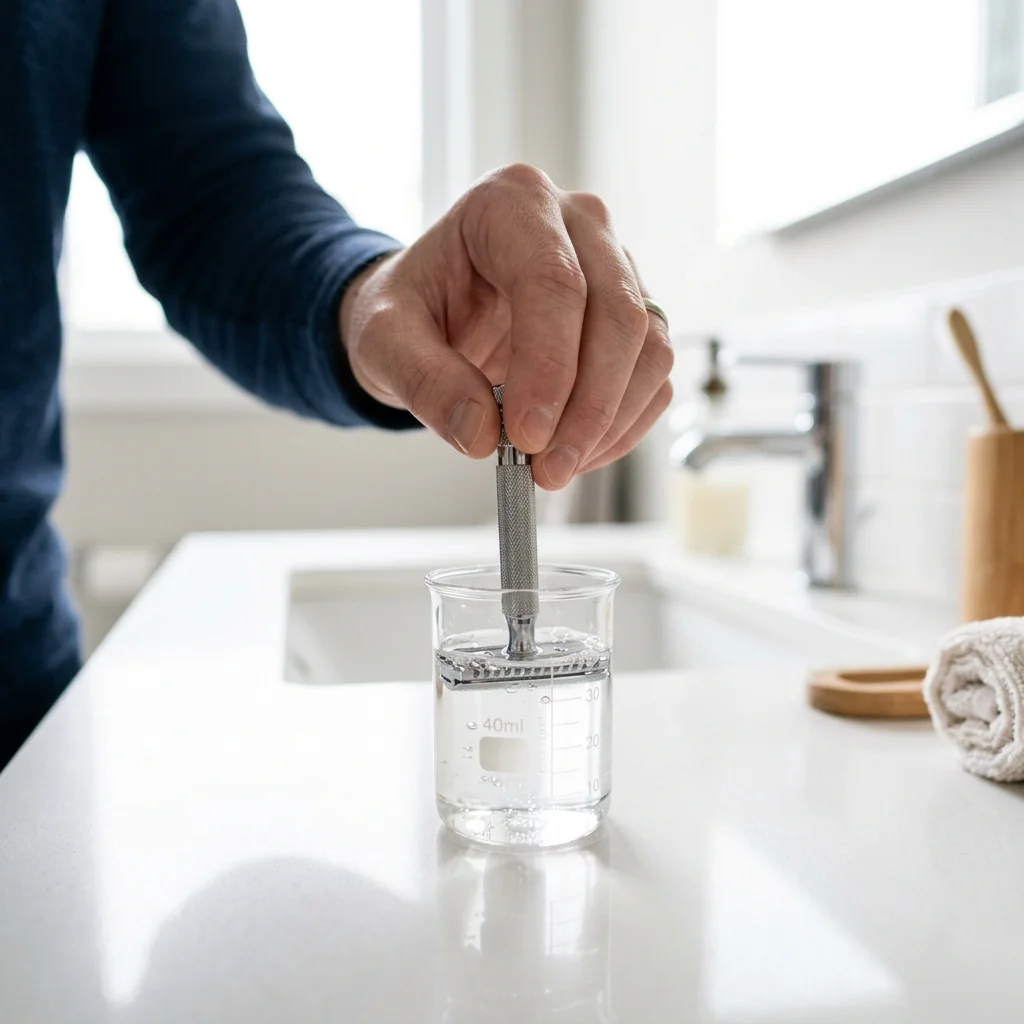
This is the single most impactful daily habit change you can make for blade longevity in a hard water area, and it takes less time to do than it does to read this sentence.
After rinsing your razor, dip the blade head briefly into a small cup or shot glass of 91% isopropyl alcohol, then shake it once and leave it to air-dry.
That's the complete technique. Here's why it works.
The Water Displacement Mechanism
What isopropyl alcohol does to water on a metal surface isn't magic — it's physical chemistry. Isopropyl alcohol and water are fully miscible, meaning they mix readily. When the alcohol contacts the thin film of hard water clinging to your blade surface, it dilutes that film and displaces it from the metal. Critically, isopropyl alcohol has a significantly lower boiling point than water (82°C vs 100°C) and a much higher evaporation rate at room temperature. As the alcohol-water mixture evaporates from the blade surface, the alcohol pulls the water along with it — and the water evaporates along with the alcohol instead of sitting on the blade and concentrating its mineral content as it dries.
The result: the blade dries in seconds rather than minutes, and it dries without leaving a mineral film. There are no ions left behind to bond into calcium deposits. The cutting edge is left clean, dry, and in essentially the same condition it was after you rinsed out the lather.
Veteran members of the wet-shaving community who use this method confirm exactly this: the alcohol dip prevents soap scum buildup completely and keeps blades performing better for longer. One long-term practitioner specifically noted that it dries the razor more quickly and also prevents soap scum buildup — two outcomes from a single 3-second step.
The Most Important Clarification: Dip, Don't Store
There is a persistent misunderstanding in online discussions about the alcohol method, and it needs to be addressed clearly before it costs you a razor.
You dip the blade. You do not store it in alcohol.
Leaving any razor — safety razor, cartridge, or otherwise — submerged in alcohol for extended periods can degrade certain finishes. If your razor handle has a lacquer or varnish coating, ethanol is a known solvent for those materials. Additionally, alcohol that isn't in an airtight container will slowly evaporate, leaving behind any mineral impurities that were dissolved in the alcohol solution — which would then deposit directly onto the blade. A dip and shake that takes 3 seconds does none of these things. A prolonged soak that goes on for hours does.
The community consensus from Badger & Blade is explicit on this point: dip in alcohol, not store. The dip chases most remaining water off your blade and lets it evaporate quickly and cleanly. That's the entire purpose — and it doesn't require more than a second of contact time to work.
Which Concentration to Use
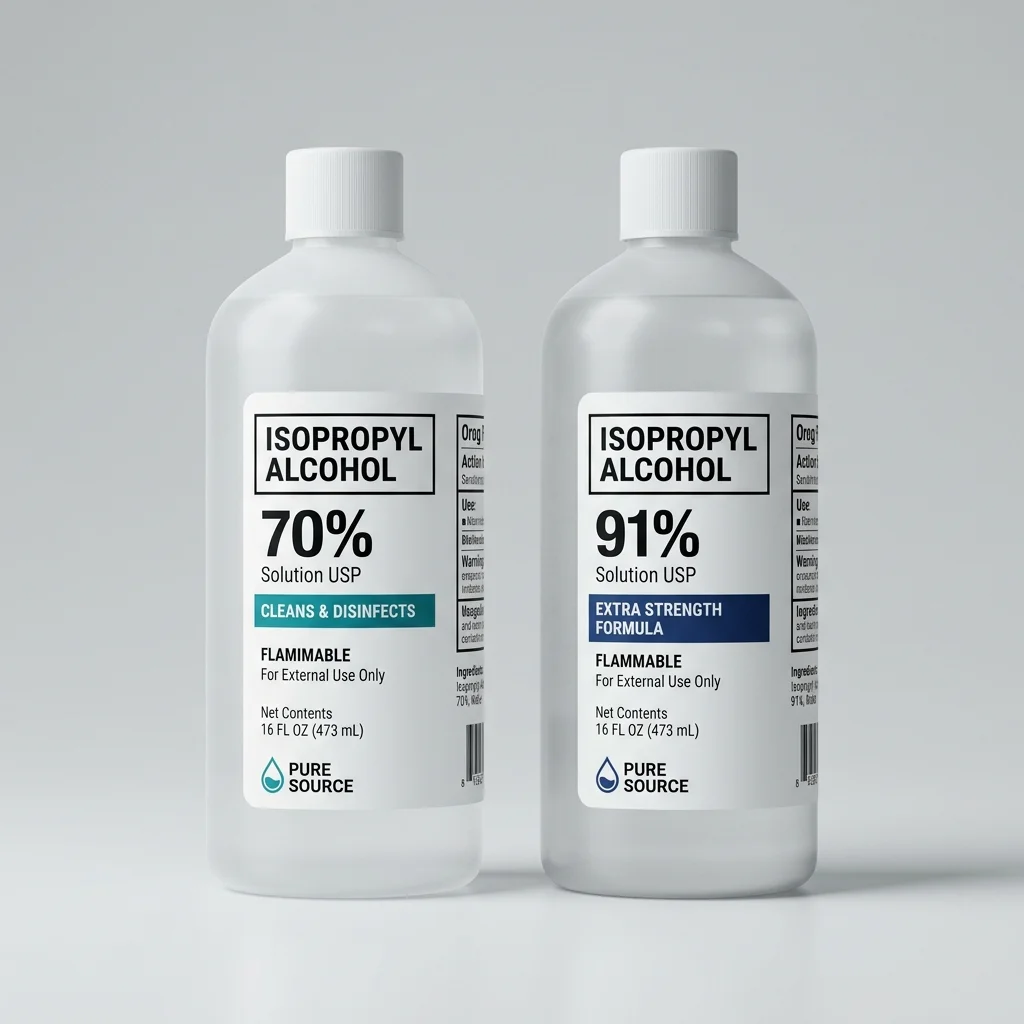
Choose 91% isopropyl alcohol over the more common 70% formulation. The math is straightforward: 70% isopropyl alcohol is 30% water. If that water contains dissolved minerals from your tap — and if you're using tap water to dilute your alcohol, it does — you're introducing the very mineral ions you're trying to avoid back onto your blade surface.
The 91% or higher formulation contains significantly less water and far fewer dissolved minerals per volume, making it a cleaner drying agent. It also evaporates faster, which is the point of the exercise.
Step-by-Step: How to Clean Hard Water Off Razor Blades and Handles
The daily alcohol dip prevents mineral buildup from forming. But what about the buildup that's already there — the white crust on your razor head, the discolored deposits around the handle threads, the calcified film inside the blade gap?
This is where most people make the mistake that destroys razors. Before the safe method, here is the warning that the forum community has been repeating for years.
⚠️ The Vinegar Disaster Warning
White vinegar is frequently recommended for removing calcium and limescale from household surfaces. It works beautifully on shower tiles, kettle interiors, and tap fixtures — because none of those things have a chrome or nickel plating layer over a brass or zamak base.
Your razor almost certainly does.
The verified community experience from Badger & Blade documents what happens when you leave a razor in undiluted vinegar, even for a short soak: the acetic acid eats through the chrome finish. What appears to be rust afterward is actually discoloration of the base metal now exposed under the damaged plating. This progressive surface damage has a name in the wet-shaving world: brassing — the point at which the chrome or nickel plating has been compromised enough that the underlying brass or zamak base metal begins to show through, typically appearing as a dull golden or brassy tone in the worn areas.
Brassing caused by chemical stripping is permanent without professional re-plating. There is no polishing it back. There is no product that reverses it. One member documented their experience boiling razors in vinegar: the SuperSpeed, the Fatboy, and the Lady Gillette all came out with "total discolouration" — brassy-colored under the hood where the chrome had been completely stripped. A razor that was worth money and gave a great shave is now cosmetically ruined.
The specific things that strip plating and must be avoided:
- White vinegar — even diluted, even briefly
- Bar Keepers Friend and similar oxalic-acid powder cleansers
- Abrasive scrubbing pads or metal-bristled brushes
- Boiling water (thermal shock can cause plating to crack and lift)
- Extended soaking in any acidic solution
The Badger & Blade safety razor maintenance guide is explicit: to avoid potentially dangerous reactions and fumes, never mix cleaning products, and avoid exposing any razor to harsh cleaning agents for prolonged periods.
The Safe Method: Community-Approved Hard Water Removal
What follows is the technique that experienced shavers across every major wet-shaving community converge on as the safe, effective, and razor-preserving approach to cleaning hard water mineral buildup from a razor handle and head.
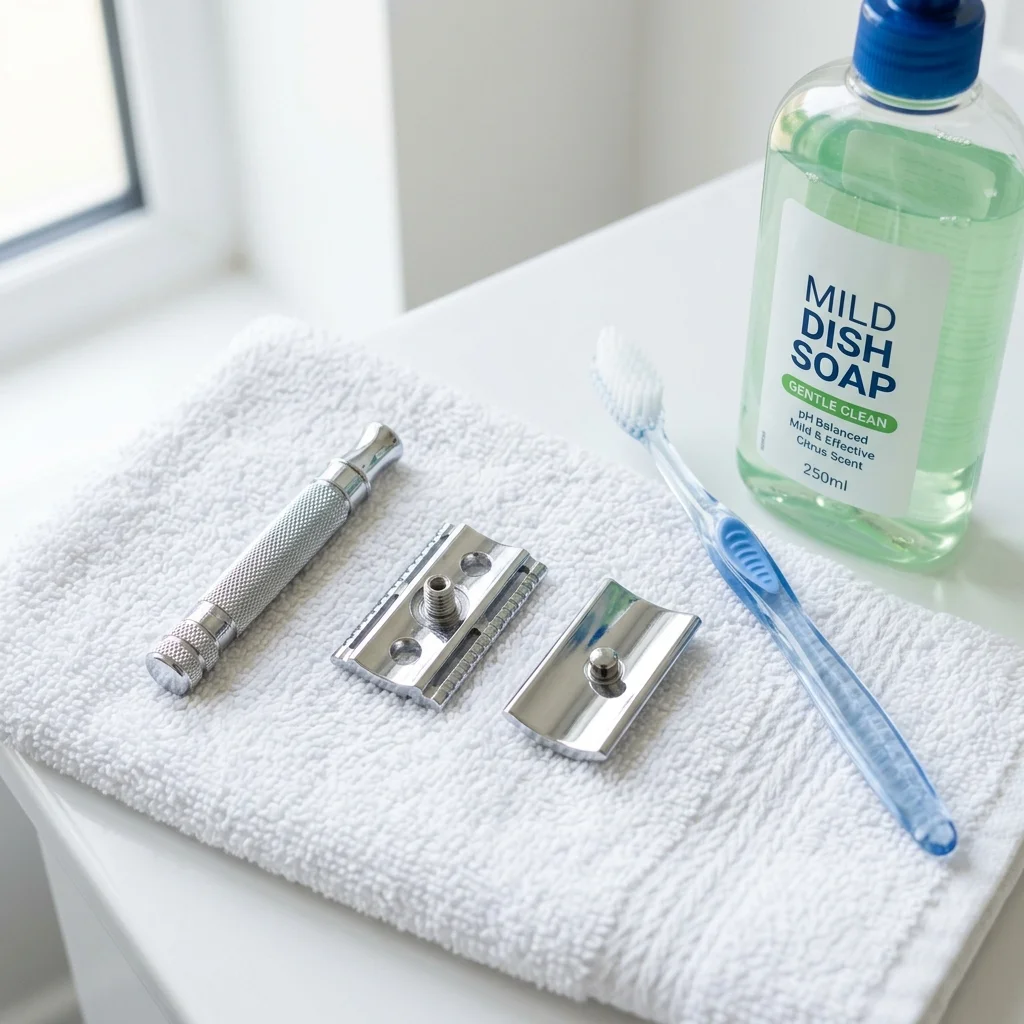
What You Need
- Hot water from the tap (as hot as possible without scalding yourself)
- A small amount of mild dish soap (Dawn or equivalent — fragrance-free is ideal)
- A soft-bristled old toothbrush
- 5–10 minutes
-
1Disassemble the razor completely.
Remove the blade (carefully — hold the blade by its flat sides, never the edges) and set it aside. Separate the top cap, base plate, and handle. Hard water deposits concentrate in the gaps and threads between these components. You cannot clean those areas with the razor assembled.
-
2Soak in hot soapy water.
Fill a small bowl or cup with the hottest tap water you can manage and add a few drops of mild dish soap. Submerge the razor components (not the blade) and let them soak for 5–10 minutes. Hot water softens and partially dissolves calcium carbonate deposits without any chemical reaction that could harm the plating. The dish soap acts as a surfactant that helps lift the loosened mineral residue off the metal surface.
-
3Brush with a soft toothbrush.
After soaking, use a soft-bristled toothbrush to work around all the threads, knurling patterns on the handle, the underside of the top cap, and the blade seating areas of the base plate. Apply light, circular pressure — the goal is to dislodge loosened mineral deposits, not to scrub aggressively. For deep knurling patterns, an even softer approach works: load the brush lightly with soapy water and use a stippling (up-and-down) motion rather than lateral scrubbing, which concentrates mechanical force on the ridges where plating tends to be thinnest.
-
4Rinse thoroughly.
Rinse all components under hot running water until no soap residue remains. Pay specific attention to the threads on the handle — soap residue left in threaded areas can degrade the zinc alloy (zamak) components that many razor handles use.
-
5Dry immediately and completely.
Pat all components dry with a clean cloth. Do not air-dry. Air-drying in a hard water area defeats the purpose of the entire cleaning — the rinse water evaporates and deposits a fresh mineral film. Dry the handle, then the top cap, then the base plate, paying attention to the inside surfaces and threaded areas.
-
6Reassemble and apply one drop of mineral oil to the threads (optional but recommended).
This is particularly relevant for zamak razors. Mineral oil on the threads creates a thin, moisture-resistant barrier that slows mineral deposit accumulation between cleaning sessions and protects the zinc alloy from the slow corrosion that hard water ions can accelerate over months of use.
How often: Monthly for most shavers in moderately hard water areas. Every two to three weeks if your water is very hard (above 300 ppm calcium carbonate, as common in cities like San Antonio, Phoenix, or Las Vegas).
Conclusion: A Clean Blade Is Only Half the Battle
The white residue on your safety razor was never a sign of a dull blade. It was a sign of mineral accumulation on a sharp one — and a preventable accumulation at that. The daily alcohol dip takes three seconds. The monthly hot soapy water clean takes ten minutes. Between those two habits, the hard water problem at the blade level is essentially solved.
But protecting the blade is only part of the hard water shaving equation. If your blade is now clean and performing correctly and your skin is still burning after every shave, the mineral film isn't just coating your razor — it's also coating the inside of your open pores during the post-shave rinse, triggering inflammation and breakouts that have nothing to do with blade quality. For that problem, the fix is different, and it starts with understanding what hard water does to your skin barrier in the 60 seconds after the razor leaves your face.
Read our dermatologist-backed breakdown of exactly how that happens and how to stop it: Hard Water Razor Burn & Post-Shave Breakouts: The Fix.
And if you want to address the root cause — neutralizing the mineral content of your tap water before it ever touches your blade, your brush, or your face — the most cost-effective solution in the entire cluster is a pinch of citric acid or half a cup of distilled water. That technique is covered in full detail in the Distilled Water & Citric Acid Shave Hack.
Sources: Controlled hard water razor blade deposition study — USPTO Patent #11193095 (30-day blade imaging test). Blade apex geometry — Biology Insights: The Science Behind the Edge (2025). Micro-galvanic corrosion mechanism — Alibaba LifeTips: Keep Razors Sharp with Mineral Oil (2026). Plating damage and vinegar warning — Badger & Blade community wiki and forum threads (Safety Razor Maintenance; Do Not Wash Razors With Vinegar). Alcohol displacement community data — Badger & Blade forum: Isopropyl Alcohol on Blades; Anyone Spray or Rinse Razor in Isopropyl Alcohol?