Table of Contents
- What Causes Razor Irritation With Hard Water?
- Hard Water vs. Soft Water for Post-Shave Cleansing
- Dermatologist Advice: How to Wash Your Face Safely
- The Brush Matters Too: A Hidden Shaving Brush Mistake
- Restoring Your Skin Barrier: Post-Shave pH and Hydration
- Frequently Asked Questions
- Conclusion: The Half You've Been Missing
You're using a fresh blade. You've been working on your lather technique. You shave carefully, rinse off, and within the hour your neck looks like you lost a fight with a wire brush. Red, burning, dotted with bumps that take days to calm down.
The standard advice won't solve this. "Use more moisturizer." "Try a sharper blade." "Go with the grain." You've probably done all of it. None of it addressed the real problem, because none of it looked at what happens in the sixty seconds after the blade leaves your face.
That film is what's burning you. That film is what's causing the breakouts. And switching your blade won't fix it.
This guide gives you the dermatologist-backed chemistry of why this happens, exactly how to stop it, and what to do in the 90 seconds after every shave to protect your skin barrier — using science, not guesswork.
What Causes Razor Irritation With Hard Water?
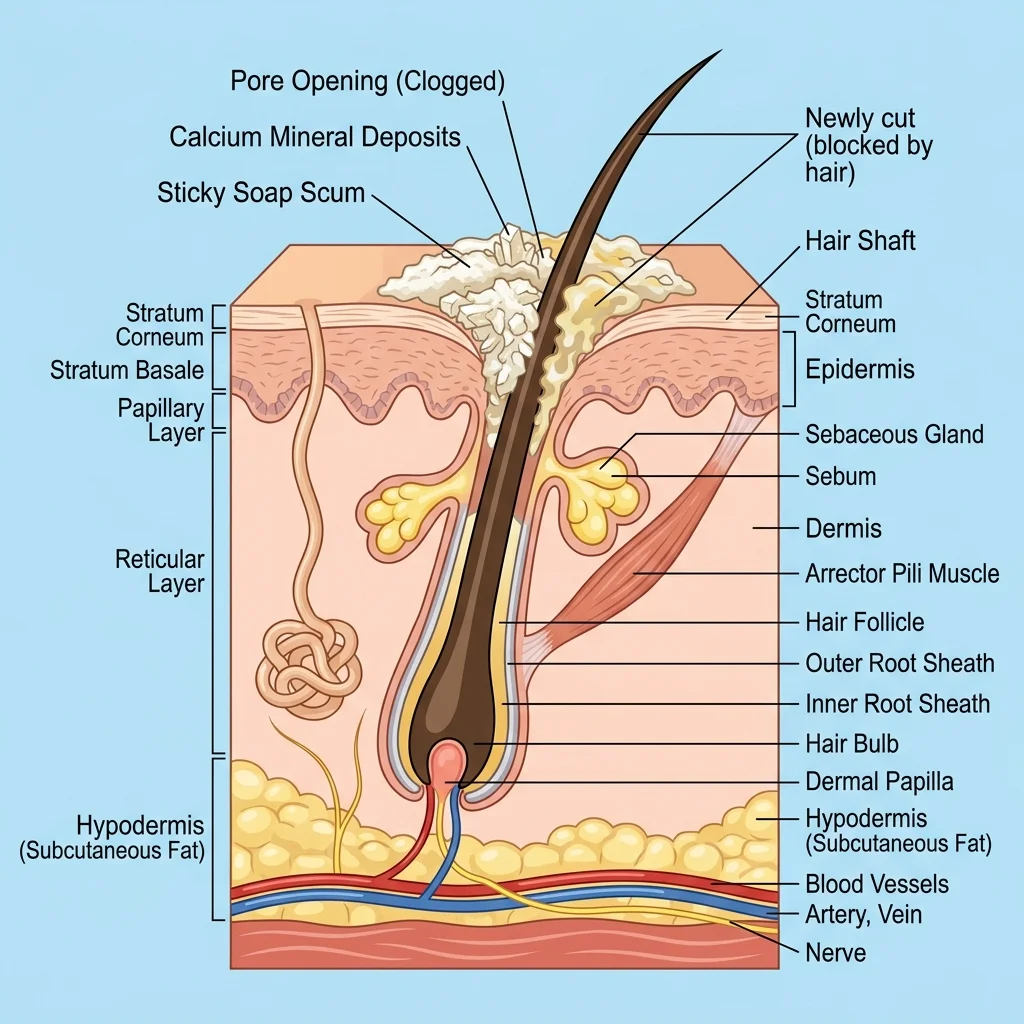
Most shaving advice focuses entirely on the wrong part of the process. Brands talk about lather quality, blade count, and pre-shave prep. But as one experienced wet-shaver accurately noted in a community forum, the real issue isn't the lather — it's the rinsing. Hard water binds to shaving cream residue during the rinse, making it nearly impossible to remove completely, leaving an invisible, pore-clogging film on freshly shaved skin.
Here is the precise chemistry of why this happens.
The Micro-Cut Window: Why Timing Matters
Every pass of a razor blade removes not just hair but the uppermost layer of the stratum corneum — the skin's outermost defensive layer. Dermatologists classify these as micro-abrasions: individually invisible disruptions to the skin surface that create a brief window of vulnerability in the barrier function. During a normal shave, your face might have tens of thousands of these micro-abrasions open simultaneously.
Under normal conditions, the skin's natural acid mantle — a thin, protective film with a pH between 4.5 and 5.5 — begins resealing these disruptions within minutes of the blade passing. The problem is that hard water interrupts this process before it can begin.
The Calcium-Soap Scum Reaction Inside Your Pores
Hard water contains high levels of calcium and magnesium minerals. According to board-certified dermatologist Dr. Sajic, both minerals react with soap and other cleansing products to form residues that are difficult to wash off, can clog pores, and directly irritate the skin — making it challenging for the skin to retain moisture and stay hydrated.
In the context of a post-shave rinse, this reaction is particularly damaging. Here's why:
- The soap residue hasn't fully rinsed away yet. Shaving cream sits on the skin in a thick layer. Even after the razor passes, residue remains in the fine skin texture, beard hair follicle openings, and micro-abrasions.
- Hard water rinse water hits this residue. The calcium (Ca²⁺) and magnesium (Mg²⁺) ions immediately bond with the fatty acid salts in the shaving soap, forming insoluble calcium and magnesium soap compounds — the same reaction that creates the crust inside your bowl.
- This reaction happens inside your open pores. The resulting insoluble soap scum doesn't rinse away cleanly. This soap scum can clog pores, leaving the face susceptible to acne breakouts. In the post-shave context, this happens inside pores that the razor has just opened wider than their resting state.
- Bacteria become trapped. The calcified soap-residue layer inside the pore acts as a physical plug. When bacterial flora — normally harmless on intact skin — get sealed beneath this layer inside a freshly opened hair follicle, the inflammatory response begins. This is the biological precursor to both razor burn and pseudofolliculitis barbae (razor bumps): the chronic, inflammatory follicle reaction that presents as the painful red papules and pustules many shavers develop on the neck and jawline.
The Pseudofolliculitis Connection
Pseudofolliculitis barbae (PFB) is a chronic inflammatory condition characterized by follicular and perifollicular papules and pustules primarily affecting the beard and neck area. While its primary mechanical cause is ingrown hair, the inflammatory severity is directly amplified by the mineral environment of the pore. Pseudofolliculitis barbae is a foreign body reaction caused by skin penetration of hairs — either before they leave the follicle or after they leave and curve back into the skin.
What most PFB literature doesn't address is the environmental catalyst: when calcium-soap scum is already clogging the follicle opening, a re-entering hair has no clear path back out. The mineral plug physically traps the hair inside the follicle, making an inflammatory reaction that might otherwise be minor into a prolonged, recurring one.
This is the mechanism behind the "I get bumps every time I shave, but nothing seems to help" pattern that thousands of men describe without resolution. The blade technique isn't the primary issue. The post-shave rinsing environment is.
Hard Water vs. Soft Water for Post-Shave Cleansing
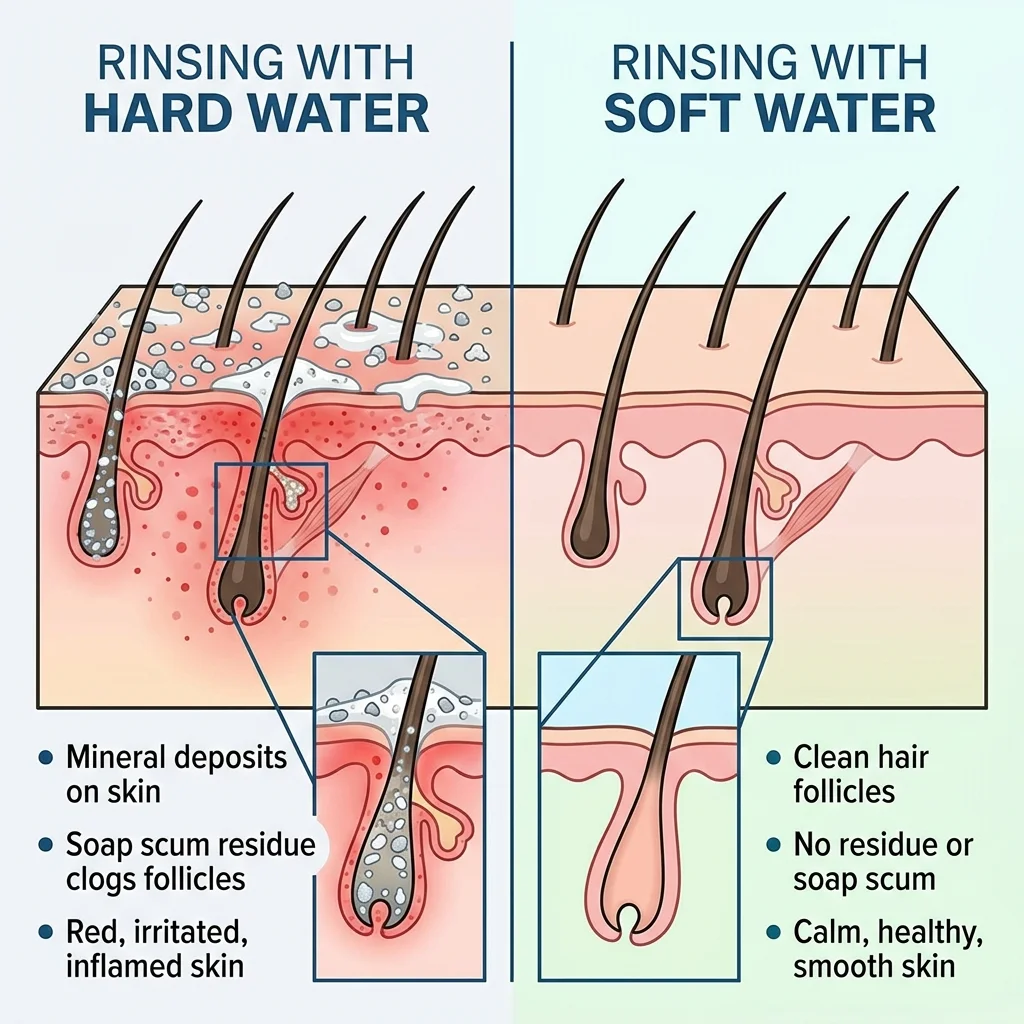
The mechanical difference between rinsing with hard water versus soft water after shaving is more significant than most people realize — and it goes beyond just soap removal.
What soft water does during a post-shave rinse:
Soft water contains very few free calcium or magnesium ions. When it contacts the soap residue on your face, it dissolves the residue cleanly and carries it away. Soft water allows soap to lather richly and — more importantly — rinse away thoroughly. Without the interference of calcium, there is no soap scum reaction. The result is no sticky residue, no clogged pores, and no friction-causing film. After rinsing with soft water, pores close back to their resting state without a mineral plug obstructing them.
What hard water does during a post-shave rinse:
The calcium and magnesium ions in hard water bond with soap residue as fast as the water touches your skin. The most common effect of hard water on the skin is causing unnecessary dryness and irritation — due to its inability to properly dissolve soaps. The unrinsed soap draws out the skin's natural oils, leading to skin that is dry, flaky, and itchy.
But the dryness is only part of the problem. The mineral film that hard water leaves behind also:
- Disrupts the skin's osmotic balance, pulling moisture from the dermis through the same channel it opened by blocking the surface
- Leaves a mechanically abrasive micro-layer on the skin surface that continues to irritate nerve endings for hours after the shave
- Alters the local pH environment around the pore, making it more alkaline and less hospitable to the beneficial bacterial flora that protect against infection
The Geographic Misconception
You might live in a hard-water area like San Antonio, Texas — consistently rated among the hardest municipal water supplies in the United States — and think: my soap lathers fine, so my water probably isn't causing problems. This is a dangerous assumption.
Lather formation and post-shave skin damage are two separate outcomes of hard water exposure. Even when shaving technique forces acceptable lather through a good soap formula, the rinse water still deposits calcium and magnesium on the skin after the blade passes. Hard water can potentially affect the pH of the skin due to its mineral content, primarily calcium and magnesium ions. For individuals with conditions like eczema or dermatitis, the disruption of the skin's pH balance caused by hard water can exacerbate symptoms. This pH disruption doesn't require visible soap scum on the face to be happening — it happens at the ionic level, invisibly, during every single rinse with hard tap water.
Dermatologist Advice: How to Wash Your Face With Hard Water Safely
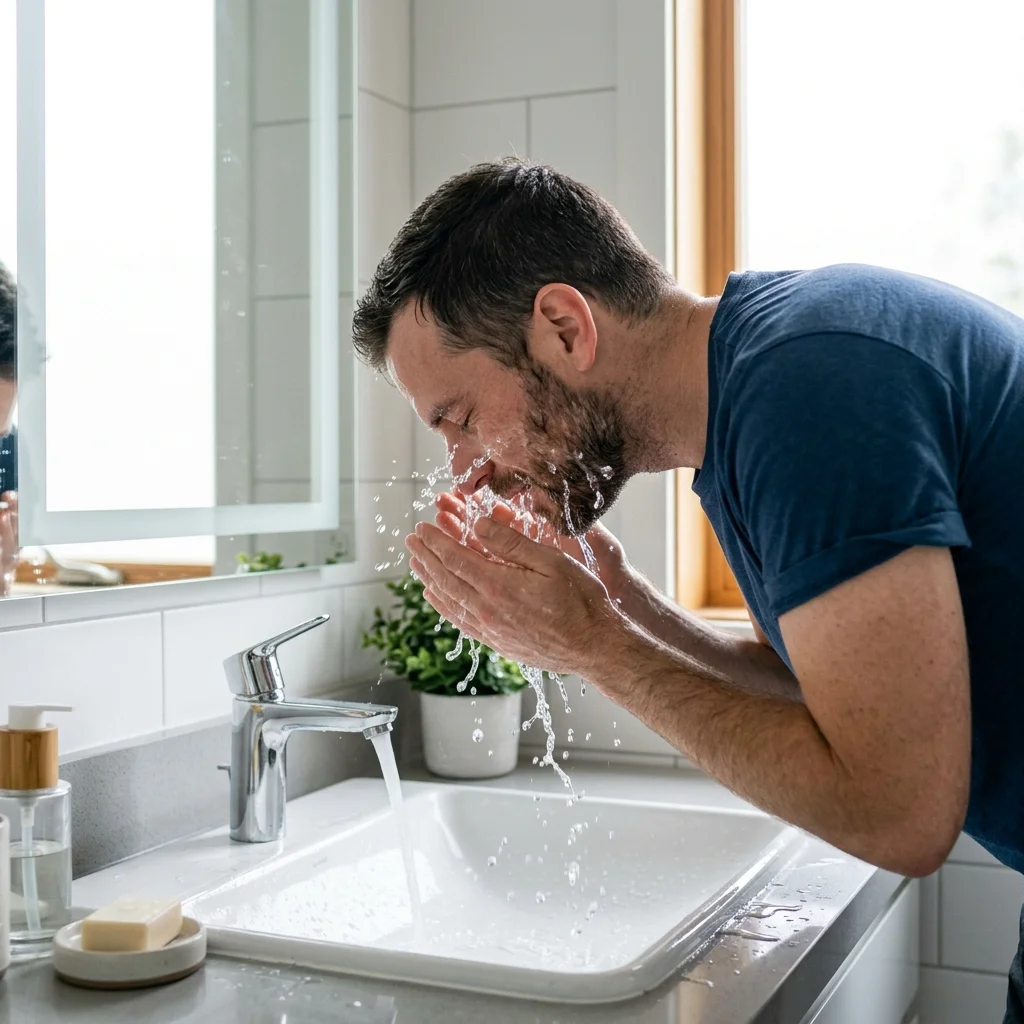
The three-step protocol below is built on dermatological principles and is specifically designed for the post-shave environment — where the skin barrier is temporarily weakened and the pores are at their most vulnerable.
Step 1 — Switch to a Syndet Cleanser for Your Post-Shave Rinse
The most impactful single change you can make is replacing traditional soap or facial wash with a syndet (synthetic detergent) cleanser for your post-shave rinse.
Traditional soap bars and most facial washes have a pH between 9 and 11 — far above the skin's natural acid mantle of 4.5–5.5. When applied to a hard-water environment, their alkalinity combines with the mineral ions in the water to create the worst possible condition for a freshly shaved face: high pH, high mineral load, and open pores.
Syndet cleansers are formulated with a pH close to the skin's natural range (around 5.5–6.5). They also contain surfactants that don't react with calcium and magnesium the way traditional soap does — meaning they rinse cleanly even in hard water, without leaving a mineral-soap film behind. Fragrance-free syndet bars are widely available and are the first recommendation in dermatological guidance for sensitive skin in hard water environments.
Step 2 — Use the Lukewarm-Then-Cold Temperature Sequence
Temperature management during the post-shave rinse is a well-established technique in dermatology, but the precise sequence matters.
The correct sequence:
- Lukewarm rinse first — Use water that's comfortably warm (not hot) to remove all shaving cream residue. Warm water maintains the pore in a slightly dilated state, which helps flush residue out rather than sealing it inside. This phase should last 20–30 seconds.
- Cool final rinse — Finish with a cool (not ice-cold) rinse. Cool water causes vasoconstriction: the small blood vessels near the skin surface contract, which reduces local inflammation and helps the pore close back toward its resting diameter. This physically reduces the window through which mineral ions and soap residue can continue to deposit inside the follicle.
What not to do: Hot water throughout the entire rinse. Hot water dilates capillaries and pores for an extended period after rinsing, keeps inflammation elevated, and increases transepidermal water loss (TEWL) — the rate at which your skin loses moisture to the atmosphere. In a hard-water environment, a prolonged hot rinse deposits the maximum possible mineral load on skin that's at maximum openness.
Step 3 — Minimize Total Hard Water Contact Time
Mineral residue plus cleanser residue can sit on skin and mix with oil and sweat, creating a heavier surface layer that feels like it blocks pores — especially on the back, shoulders, jawline, and shaving areas.
The longer hard water sits on a freshly shaved face, the more calcium and magnesium ions have time to bond with soap residue and penetrate open pore openings. Practical implications:
- Don't stand under the shower spray with an unprotected, freshly-shaved face for more than 30–60 seconds after rinsing off the soap
- Pat dry immediately after the cool rinse — do not rub, and do not air-dry (which leaves a mineral residue film as the water evaporates from the skin surface)
- Apply your toner or moisturizer within 60–90 seconds of patting dry, while the skin surface is still slightly damp — not to lock in the hard water, but to establish a protective barrier before the calcium film dries and hardens
The Distilled Water Final Rinse Hack
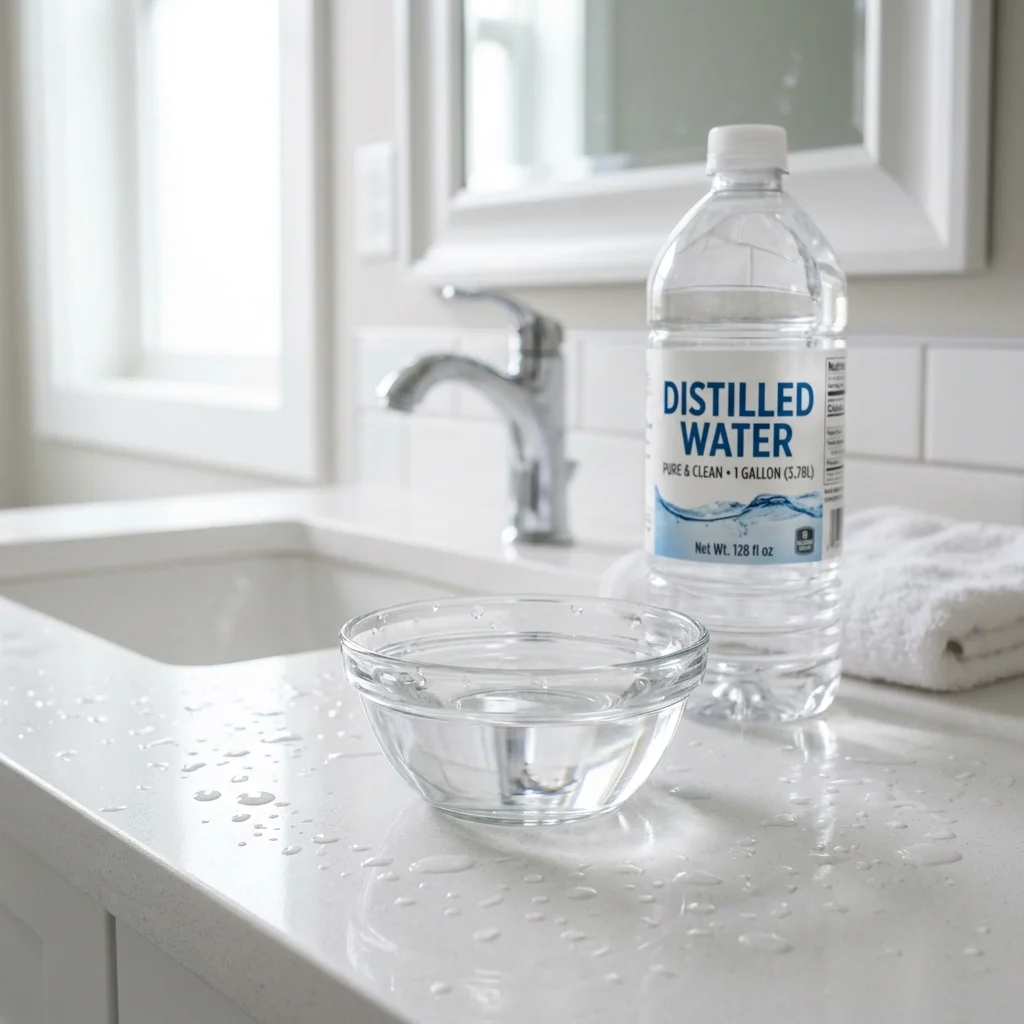
If your tap water is aggressively hard and your skin is highly reactive, there is a more direct solution that community consensus strongly endorses: a distilled water final rinse.
After completing your normal post-shave rinse with tap water, fill a small cup or bowl with room-temperature distilled water (or heat it briefly in the microwave) and use it as the last thing that touches your face before you pat dry. The distilled water — which contains zero calcium or magnesium ions — physically displaces the mineral-laden tap water from your pore openings and the surface of your skin.
This final splash removes the ionic mineral film before it has a chance to dry and harden into the calcium residue that causes prolonged post-shave irritation. It's a 10-second step that many reactive-skin shavers describe as transformative. If you're already using distilled water in your shaving routine as described in our complete distilled water and citric acid shaving guide, the same bottle does double duty — for building better lather and for rinsing your face afterward.
The Brush Matters Too: A Post-Shave Mistake That Compounds Hard Water Damage
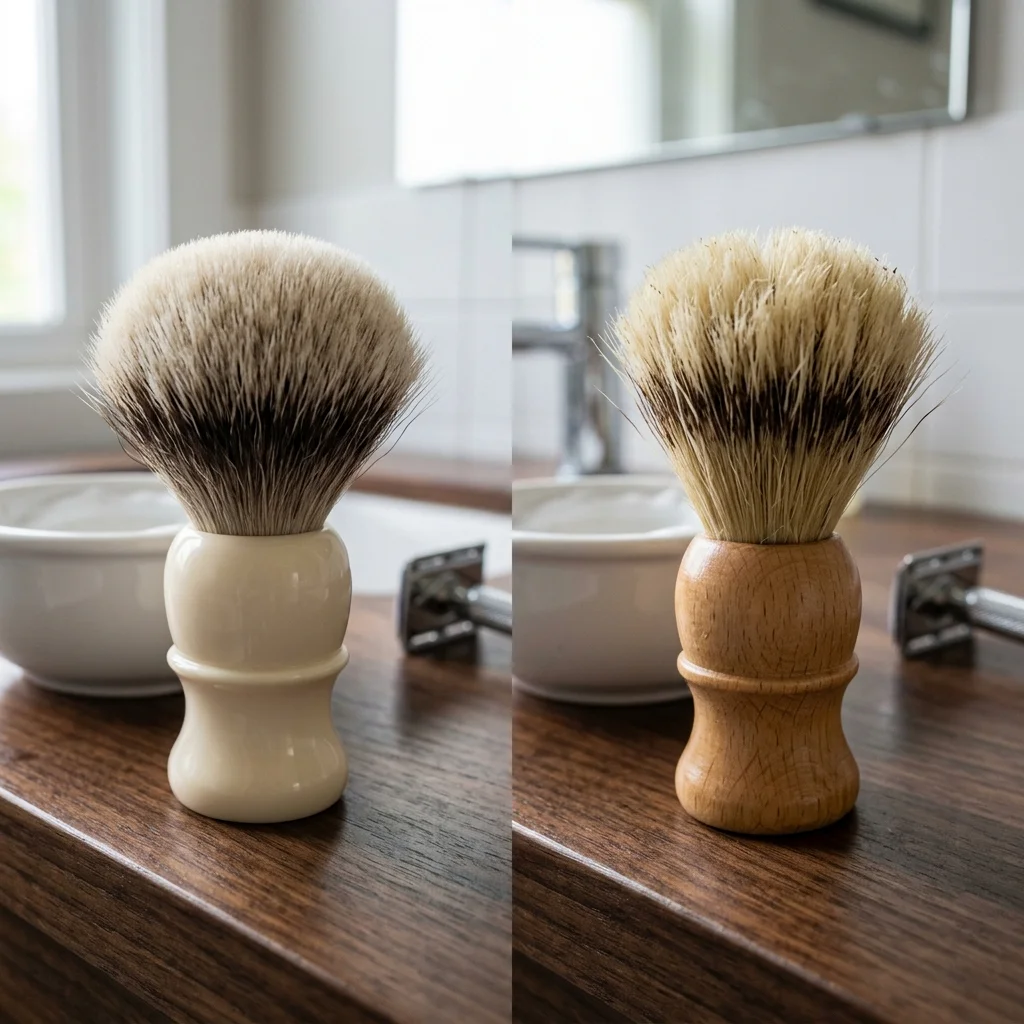
There is a specific brush-type mistake that experienced wet-shavers have identified as a hidden amplifier of hard water skin damage — one that almost no mainstream shaving article discusses.
Ultra-soft bristles fail to emulsify the soap properly in hard water.
Experienced shavers have found that very soft brush types — particularly high-grade silver tip badger — lack the mechanical stiffness needed to agitate the soap molecules vigorously enough to build a stable emulsion when hard water minerals are interfering with the process. The result isn't just weak lather: it's a lather that contains larger, unmicronized soap particles that don't provide a uniform coating film on the skin surface.
When you rinse this kind of lather off with hard water, those larger soap particles bond with calcium ions into correspondingly larger soap scum deposits — ones that are more likely to physically obstruct pore openings rather than being flushed away cleanly.
The practical recommendation from the community: In hard water conditions, boar hair and horse hair brushes — both stiffer than silver tip badger — provide better mechanical emulsification of the soap. One experienced wet-shaver noted that horse hair bristles "rip through" the mineral resistance in a way that soft brushes cannot, producing a more properly emulsified lather that rinses more completely. The post-shave skin quality difference, they observed, was noticeable.
This doesn't mean you need to replace your brush entirely. But if you're using an ultra-soft brush in a hard water area and experiencing persistent post-shave breakouts, the brush is worth considering as a contributing variable.
Restoring Your Skin Barrier: Post-Shave pH and Hydration
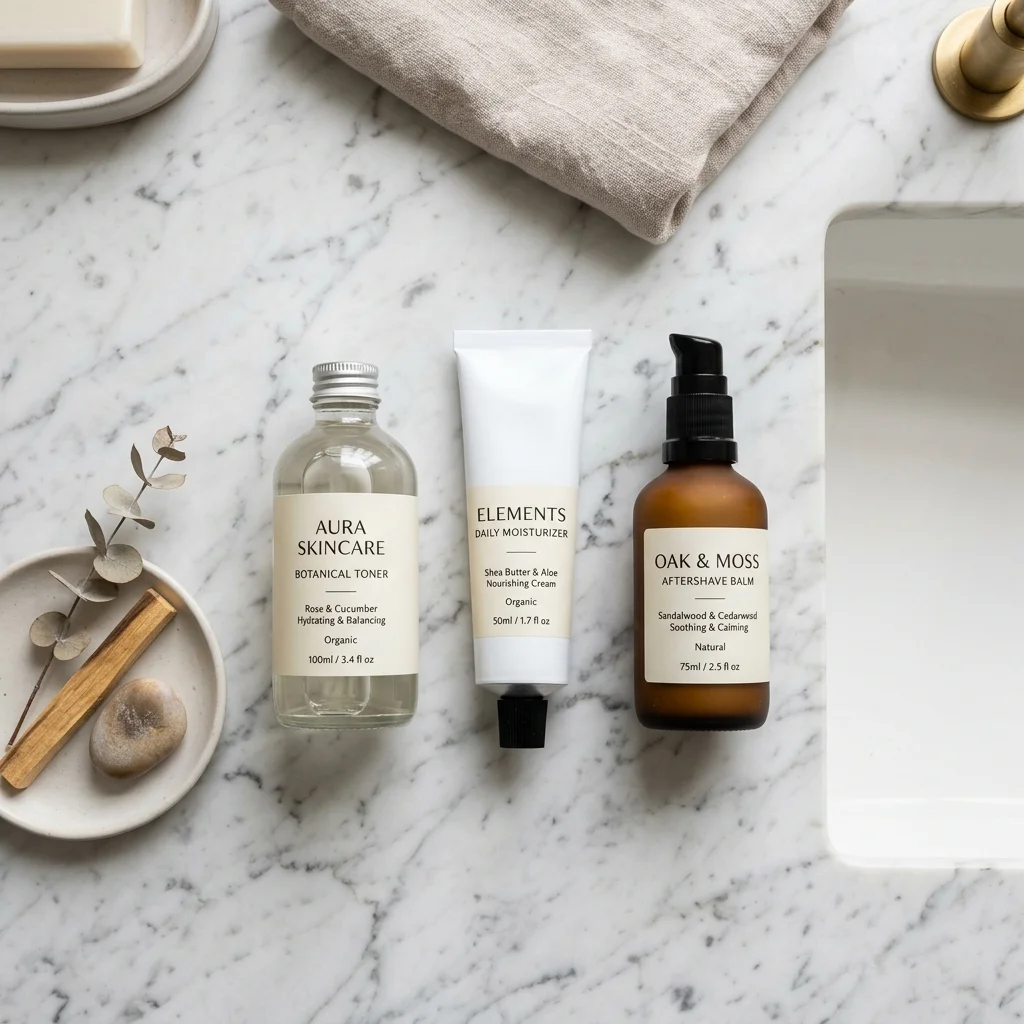
The final and most frequently skipped part of the hard water damage equation is pH restoration. Most shaving advice stops at "apply an aftershave." But aftershave — particularly alcohol-based formulas — doesn't restore your skin barrier. In hard water conditions, it can actively damage it further.
Why Post-Shave pH Restoration Is Non-Negotiable
Your skin's acid mantle has a natural pH between 4.5 and 5.5. This acidic environment serves three critical functions:
- Antimicrobial defense: Acidic pH favours the growth of normal skin flora and inhibits pathogenic bacteria. Certain antimicrobial peptides like dermcidin offer greater than 90% bactericidal effect against Staphylococcus aureus at pH 5.5 — but at pH 6.5, that bactericidal effect drops to just 60 percent. A shave in hard water can push your skin surface to pH 8–9, dropping your natural antimicrobial effectiveness by more than half.
- Barrier integrity: Disruptions in the acid mantle's pH balance have been linked to various dermatologic conditions. An alkaline pH can compromise the skin barrier, leading to increased trenegligible water loss (TEWL) and vulnerability to infections or inflammatory skin disorders including atopic dermatitis and acne.
- Enzyme regulation: The acid mantle contributes to the regulation of the microbiome, structural stability, and inflammation. Skin pH is pivotal in maintaining the integrity of the epidermal barrier, and shifts in pH can disrupt barrier properties with implications in both healthy and diseased skin.
Hard water typically registers a pH above 8.5, making it especially alkaline — and that alkalinity is transferred directly to your skin surface during a rinse. Every shave in hard water pushes your acid mantle significantly above its healthy operating range.
The Winter Amplification Effect
The pH disruption caused by hard water is bad in any season. In winter, it becomes severe. When skin is exposed to cold, dry air, its natural moisture levels drop and the acid mantle thins. A hard-water rinse on top of already-compromised winter skin acts as a desiccant — pulling moisture from the epidermis through the disrupted barrier instead of conditioning it. One user in a wet-shaving forum described exactly this experience: they were worried that incomplete rinsing was making their skin worse in winter, noting that their skin was "extremely dry per usual in harsh winter." They were right to be concerned. The combination of cold weather barrier thinning and mineral-soap film accumulation is the most aggressive scenario for post-shave skin damage.
The Post-Shave pH Protocol
This three-step sequence should happen within 90 seconds of your final rinse:
- Step 1 — Apply a pH-balanced, alcohol-free toner.
This is the most important step that most men skip entirely. A good toner removes the alkaline mineral residue from the skin surface and brings the pH back toward the acid mantle range. Look for toners with pH 5.0–5.5 and no alcohol. Witch hazel-based toners are a common choice, but they vary significantly in formulation — check that the pH is stated and that alcohol is not in the first five ingredients.Why not alcohol-based aftershave? Alcohol aftershaves have a pH near 7 (neutral) and contain ethanol, which is a known skin barrier disruptor. In the context of a freshly shaved, hard-water-rinsed face with open pores and a compromised acid mantle, applying an alcohol-based aftershave amplifies barrier damage rather than addressing it. - Step 2 — Apply moisturizer or balm within 60 seconds of the toner.
Applying a moisturizer, ointment, or lotion within three minutes of stepping out of the shower helps lock in moisture — a recommendation often made in dermatology for managing atopic eczema. For post-shave hard water conditions, the same principle applies: you need to establish an occlusive moisture barrier while the skin surface is still slightly damp from the toner. Once the mineral film dries and the pH remains elevated, the moisture loss accelerates rapidly. - Step 3 — Avoid touching your face for 10–15 minutes.
Pore closure after shaving is a slow mechanical process. The 90 seconds of the rinse-and-toner-and-moisturize sequence buys you the protection you need, but it only works if you give the skin uninterrupted time to begin the barrier restoration process. Repeated touching, reapplication of product, or exposure to more tap water resets the clock.
Frequently Asked Questions
Test it. Do a single shave using distilled water for all rinsing — no tap water at any stage — and apply your normal post-shave routine. If the irritation reduces significantly or disappears, your water is the primary cause. If irritation persists with distilled water rinsing, the issue is more likely technique, blade pressure, or product sensitivity. The distinction matters because the fixes are completely different.
Almost certainly. Alcohol-based aftershave applied to a face that has been rinsed with alkaline hard water is being applied to skin that already has a compromised barrier and elevated pH. The alcohol interacts with an already-disrupted acid mantle, which dramatically amplifies the sting. Switching to an alcohol-free post-shave balm, applied after a pH-balancing toner, typically eliminates the majority of that stinging sensation. The problem isn't the aftershave's strength — it's the condition of the skin it's meeting.
A whole-home water softener is the most thorough solution, and for many shavers it is transformative. Soft water allows soap to rinse away thoroughly — without the interference of calcium there is no soap scum reaction, leaving no sticky residue, no clogged pores, and no friction-causing film. However, softeners replace calcium and magnesium with sodium ions, and some people with very sodium-sensitive skin notice a different kind of residue. The investment is also significant. For most people, the distilled water rinse and pH-restoration protocol described in this guide achieves 80–90% of the benefit at a tiny fraction of the cost.
What you're describing is the timeline of pseudofolliculitis barbae (PFB) rather than razor burn. Razor burn appears immediately and fades within hours. PFB develops over 1–3 days as the shaved hair begins to regrow and, in some follicles, curves back into the skin wall rather than growing outward. The inflammatory response builds over this period. Hard water accelerates and worsens PFB specifically because the mineral-soap scum plug inside the pore physically obstructs the follicle opening — meaning re-entering hairs have a narrower or partially blocked exit path, making the inflammatory reaction more likely and more severe. The solution targets both the obstruction (syndet cleanser, distilled water rinse) and the inflammation cascade (pH-balanced toner, immediate moisturization).
Conclusion: The Half You've Been Missing
Most shaving advice gives you the first half of the equation: lather, blade angle, prep. The second half — what happens at the rinse — is the one that determines whether your skin recovers cleanly or spends the next three days inflamed.
If your water is hard, the rinse is not neutral. It's an active chemical event that deposits a mineral-soap film inside open pores, drives your skin's pH into the alkaline range, depletes your natural antimicrobial defense, and traps the bacterial flora that cause breakouts. None of that is visible. All of it is fixable.
The protocol in this guide — syndet cleanser, lukewarm-then-cool rinse, distilled water final splash, alcohol-free pH-balanced toner, immediate moisturization — addresses every stage of that process. It costs less than $20 total to implement and takes under two minutes added to your existing routine.
For the first half of the equation — choosing the right soap that builds hard-water-resistant lather before the blade even moves — check out our data-backed guide to the best shaving creams and soaps for hard water, including which formulas contain EDTA chelating agents. And if you want the cheapest and most effective way to build perfect lather in hard water without buying new products, our distilled water and citric acid shaving guide covers the complete method.
Pseudofolliculitis barbae pathophysiology — DermNet NZ, Clinical and Experimental Dermatology (Oxford Academic, 2023), PubMed NCBI. Skin acid mantle and pH — Journal of Integrative Dermatology (2024), Indian Journal of Dermatology, Venereology and Leprology; ScienceDirect (2024). Hard water and skin barrier — Westlake Dermatology, HealthCentral (2023), Frizzlife (2026). Community data: r/wicked_edge, r/wetshavers, r/BudgetShaving.